
The Ultimate Guide to Scuba Diving in Playa del Carmen
Playa del Carmen is one of the rare dive destinations where a single hotel can put you within reach of warm Caribbean reefs, freshwater cenotes, Cozumel's famous walls, seasonal bull sharks and some of the most important flooded caves on Earth.
Playa del Carmen is one of the rare dive destinations where a single hotel can put you within reach of warm Caribbean reefs, freshwater cenotes, Cozumel's famous walls, seasonal bull sharks and some of the most important flooded caves on Earth.
That range is the real reason to come. A beginner can take a first breath underwater in a pool before making supervised ocean dives. A newly certified diver can build confidence on the local reefs and visit a bright, spacious cenote cavern. An experienced recreational diver can combine deeper cenotes with Cozumel drift diving. A trained cave diver can spend an entire holiday exploring radically different cave systems, while a diver ready to progress can begin sidemount, cavern or cave training.
This guide explains what each type of diving involves, who it suits, how to plan a multi-day itinerary and where the boundaries lie between recreational cavern diving, certified cave diving and technical diving.
Scuba diving in Playa del Carmen at a glance
- Best overall reason to stay here: exceptional variety from one practical base.
- Main environments: Playa del Carmen reefs, cenote caverns, underwater caves, Cozumel reefs and seasonal bull shark sites.
- Beginner options: Discover Scuba Diving and Open Water training, plus local reefs after certification.
- Certified-diver options: reef, cenote and Cozumel trips selected for the diver's qualification and recent experience.
- Specialist options: guided cave diving and sidemount, cavern, Intro to Cave and Full Cave training.
- Typical cenote temperature: approximately 24–26°C/75–79°F throughout the year.
- Typical dive-trip rhythm: two dives in a half day on the local reefs; a longer inland day for cenotes; a morning-to-early-afternoon direct-boat day for Cozumel.
- Best trip length: three diving days reveal the destination's range; five to seven days allow a progressive recreational or cave-focused program.
- Seasonal highlight: bull shark observation generally runs from around mid-November into March, subject to the animals and conditions.
Why Playa del Carmen is such a strong dive base
Playa sits at the center of several distinct diving regions. The town's reefs are only a short boat ride offshore. Cenotes begin south and inland along the Riviera Maya. Cozumel lies across the channel. The bull sharks visit waters close to Playa during winter. Meanwhile, the limestone beneath the Yucatán Peninsula contains an immense network of flooded passages.
The scale of that underground world is difficult to overstate. The Quintana Roo Speleological Survey, a long-running cave-data repository supported by the National Speleological Society, reported more than 1,700 kilometers of surveyed underwater passage in its latest indexed summary. Survey totals continue to change as explorers find and connect passages. The International Union of Geological Sciences also recognizes the extraordinary geological, paleontological and archaeological value of the region's flooded systems.
This concentration of reefs, caverns and caves is why Playa works for mixed groups. One person can train, another can make recreational dives, and non-diving companions still have beaches, food, archaeological sites and cenote-swimming trips available. It is also why good planning matters: the most famous site is not automatically the right site for every diver.
The different types of diving available
Playa del Carmen reef diving
The local reefs provide warm-water boat diving within minutes of shore. Expect sand channels, coral structures, sea fans and schools of tropical fish, with possible turtles, rays, moray eels and larger visitors. Some sites are relaxed; others involve more current or depth. The local reef day is especially useful for newly certified divers, divers returning after a break and visitors who want a good half-day option.
Jaguar Divers' current Playa del Carmen ocean-diving program normally includes two guided dives, with morning and afternoon departures available according to conditions and logistics. The center limits its guided groups to four divers per guide and matches participants by experience and comfort where possible.
Recreational cenote cavern diving
This is the experience most visitors mean when they say they want to “dive a cenote.” Certified recreational divers follow a planned route in the cavern zone with a qualified guide. The dive may pass beneath a rock ceiling, but the route stays within defined recreational limits and retains a visible connection to natural light.
The attractions are geological rather than reef-like: brilliant shafts of sunlight, freshwater clarity, limestone columns, fossils, haloclines and, at selected deeper sites, hydrogen-sulfide layers. Some cenotes feel broad and luminous; others feel darker, tighter or more psychologically demanding. Depth alone therefore does not determine difficulty.
Certified cave diving
Cave diving begins beyond recreational cavern limits. Natural light may disappear, the route back to open water becomes longer or more complex, and divers must manage an actual overhead environment using specialist training, equipment, gas rules, line procedures and team protocols.
A standard Open Water or Advanced certification does not authorize cave penetration. Even a highly experienced ocean diver must complete appropriate overhead-environment training before entering the cave zone. Jaguar Divers offers guided cave diving for qualified cave divers and publishes a progression through Cavern, Intro to Cave and Full Cave training.
Sidemount and technical diving
Technical diving is a broad category. It can include planned decompression, different breathing gases, multiple cylinders, rebreathers, deeper exposures and overhead environments. Cave diving and technical diving overlap, but they are not synonyms: some cave dives remain within no-decompression limits, while some technical dives take place in open water.
Sidemount places cylinders along the diver's sides instead of on the back. Its benefits can include independent gas supplies, accessible valves, streamlined movement and flexibility in passages of different shapes. It requires training and precise equipment configuration; it is not simply a different way to clip on tanks. Jaguar Divers' published Sidemount course is a minimum four-day foundation unless combined with other training, and the center recommends the configuration for much of the local cave environment.
Availability of advanced technical support, gases, equipment and suitable sites should always be confirmed before travel. A diver using doubles, stages, trimix or a rebreather should send exact certification, configuration and objective details rather than assuming every recreational operation supports them.
Cozumel drift diving
Cozumel's reefs are part of a protected national park and the wider Mesoamerican Reef system. Current often turns these dives into elegant drifts: establish buoyancy, stay with the guide and let the water carry the group along walls, ridges and coral gardens. The exact sites are normally selected on the day for the sea state, current, park rules and group ability.
Jaguar Divers runs a direct dive boat from Playa del Carmen to Cozumel. Its standard schedule meets at the shop at 7:30 a.m. and aims to return at about 1:30 p.m., avoiding the passenger ferry and island transfer. Open Water certification is sufficient for appropriate sites, while deeper walls and stronger currents require the right experience and conditions.
Bull shark observation diving
Pregnant female bull sharks seasonally visit the waters off Playa del Carmen. Jaguar Divers' seasonal-diving information places the usual window from mid-November through as late as March and specifies observation without feeding. Wildlife never follows a guaranteed timetable, so dates, sightings, minimum experience and daily conditions must be confirmed before booking.
Night diving
A night dive transforms a familiar reef. Nocturnal animals emerge, the diver's attention narrows to the torch beam and colors become vivid at close range. It is a rewarding option for comfortable certified divers with reliable buoyancy and light-handling skills. Conditions, minimum participation and departure time determine availability.
Discover Scuba Diving and courses
Non-certified visitors can try scuba without committing immediately to a certification. Jaguar Divers' Discover Scuba Diving experience combines an introduction, pool skills and two supervised ocean dives; its published minimum age is ten. It is an experience, not a license to dive independently.
Those who want a lasting qualification can complete an Open Water course, followed later by Advanced, Rescue, Nitrox, Deep and professional training. The published standard Open Water format includes home study and approximately two and a half practical days, although individual progress, weather and scheduling can change the plan.
Cavern diving versus cave diving
The distinction is a safety boundary, not marketing vocabulary.
On a recreational cavern dive, the guide selects a route designed to remain in the entrance zone, within the applicable distance and depth limits, with a continuous route toward open water and natural light visible. Divers still encounter an overhead, so they must follow the line, control buoyancy, monitor gas and remain with the guide.
On a cave dive, the team intentionally travels beyond that zone. Training covers failures and navigation problems that an open-water course does not: lost-line and lost-diver procedures, light failures, gas sharing in restricted conditions, guideline work, disciplined gas planning, propulsion techniques, team positioning and exit management.
Jaguar Divers' own detailed cavern-versus-cave explanation makes the practical rule clear: recreational visitors dive a guided cavern route; cave-certified teams may plan cave penetration within their training. A guide does not turn an uncertified cave dive into an acceptable recreational dive.
Why the Riviera Maya is the world's premier cave-diving destination
Calling any destination “the best” involves judgment, but the Riviera Maya has a uniquely strong claim to being the world's leading cave-diving region.
First, there is the sheer surveyed scale. Multiple systems extend for hundreds of kilometers, and exploration is active. Second, the caves offer unusual diversity: immense backmount passages, delicate decorated rooms, shallow training areas, deeper sections, haloclines, restrictions and complex mazes. Third, many entrances are reachable by road from a functioning tourist city. Fourth, the region has a mature community of explorers, instructors, guides, equipment technicians and specialist support.
Conditions are another differentiator. Many local caves have exceptionally clear water and little flow compared with other major cave regions. That does not make them easy or remove overhead hazards. It does make geological detail, line awareness and team communication unusually visible when divers maintain good technique.
Finally, the caves are more than a sporting venue. They preserve evidence of changing sea level, past climate, extinct animals and early people. Formations grew when passages were dry; rising seas later flooded them. The mix of fresh and saline water creates haloclines, and collapsed roofs create the openings now called cenotes. Every fin movement takes place inside part of the region's aquifer and natural archive.
Choosing cenotes for your experience level
A first cenote experience
Bright, spacious routes with manageable depth are normally the best introduction. Chac Mool and Kukulkán offer natural light and several classic cenote features. Dos Ojos offers two famous shallow routes with extensive formations and is also suitable for snorkeling companions. The final selection should still consider recent experience, buoyancy and comfort beneath an overhead.
An Open Water diver with good buoyancy
Selected shallow cenotes can be appropriate. Dos Ojos reaches about 10 meters on its recreational routes, while Kukulkán is published with a maximum depth around 15 meters. Casa Cenote offers an open, mangrove-lined environment with more aquatic life than many inland sites. Certification depth is only one factor: a responsible operator also assesses trim, air use and how the diver responds to confined spaces.
An Advanced diver
Deeper or more complex-feeling options become possible. El Pit descends to approximately 30 meters on the recreational dive and contains a dramatic halocline and hydrogen-sulfide layer. Angelita, Zapote, Maravilla and Yaakun offer other distinctive advanced experiences. These should be treated as considered progression, not names to collect as quickly as possible.
A strong photographer
Nicte Ha is known for vegetation, natural light and broad photographic scenes; Dos Ojos and the light-beam cenotes can also be spectacular. Camera fees and rules vary, and some sites prohibit personal underwater cameras. More importantly, a camera should be added only after the diver can hold position and protect the formations without using hands, knees or fins for support.
A qualified cave diver
The correct choice depends on cave certification level, recent cave experience, configuration, desired navigation and the team's demonstrated skills. Jaguar Divers highlights large systems such as Nohoch and Vaca Ha for backmount-style passages and smaller routes such as Xulo and Minotauro for sidemount. This is where a conversation with a local cave instructor is more useful than a generic “top ten” list.
When is the best time to dive?
There is no single bad month for cenotes. Their water temperature and visibility are relatively stable, and inland diving is often possible when ocean conditions are poor. Seasonal differences matter more for the sea, surface weather, crowds and the combination of activities you want.
November to April
This is generally the drier, more comfortable period on land and the busiest tourism season. It overlaps with the normal bull shark window and is excellent for a varied itinerary. North winds can still create rough seas or port closures, so no season guarantees daily ocean access.
May to October
Expect greater heat, humidity and rain risk. Atlantic hurricane season officially runs from June 1 to November 30 according to NOAA, although a named season does not mean a storm is present throughout it. Flexible travelers can find quieter periods, but travel insurance and movable plans become more valuable.
Sargassum and diving
Sargassum affects beaches unevenly and can change quickly with wind and currents. It is mainly a shore issue rather than a reliable measure of offshore dive quality. Cenotes are unaffected by seaweed, and Cozumel's leeward dive sites may have very different conditions from mainland beaches. Check Playa del Carmen's municipal sargassum updates near the date of travel instead of planning from a yearly prediction.
How many dive days should you plan?
One day
Choose the experience that brought you here. For a first cenote visit, select an appropriate two-dive cenote day. For a relaxed ocean outing, make two local reef dives. If Cozumel is the priority, book the direct-boat day and retain some schedule flexibility for weather.
Two days
Combine one cenote day with either Playa reefs or Cozumel. A returning diver can use the local reef day first to regain comfort, then visit a cenote. An active, recently diving guest may reverse the order according to conditions.
Three days
The classic overview is one day each of local reefs, cenotes and Cozumel. In bull shark season, experienced divers may replace or extend the Playa day with a shark observation dive. This itinerary shows the three environments without rushing several cenotes into one visit.
Five days
A strong recreational plan can progress from local reefs to a bright cenote, then Cozumel, a rest or non-diving day, and a more advanced cenote selected after the first dives. The sequence gives the guide real evidence about buoyancy, air use and comfort.
Seven days for cave or technical divers
Specialist trips need more margin. Allow time for equipment assembly, a skills assessment, progressive dives, rest, site changes and weather or access adjustments. Training should not be compressed around a fixed list of caves. If starting a formal cave course, use the published minimum duration only as the floor; mastery may require longer.
What a typical dive day looks like
For Playa reef diving, Jaguar Divers normally meets at 7:30 a.m. for a morning departure or 11:30 a.m. for an afternoon trip. Divers confirm certification, fit equipment, receive a site and safety briefing, walk to the boat and make two dives with a surface interval. The reefs are close, so a morning trip often returns around noon.
A cenote day starts with equipment preparation at the shop, followed by an inland drive. At the site, the guide completes registration, explains local conservation rules, gives an overhead-specific briefing and leads the first dive. Lunch and a surface interval separate the dives. Return time varies with the cenote, traffic, access road and whether the itinerary uses one entrance or two.
The standard direct Cozumel day meets at 7:30 a.m., departs by dive boat, makes two guided drift dives with lunch and a surface interval, and aims to return around 1:30 p.m. Times are planning guides, not promises; weather, port instructions and dive profiles can change them.
Equipment and what to bring
Bring your certification card, swimwear, a towel, dry clothes, refillable water bottle, personal medication and any dive equipment you prefer. A light layer or windbreaker is useful after boat dives in winter. For cenotes, stable footwear helps on wet stairs and uneven ground.
Many divers prefer a full 5 mm wetsuit in 24–26°C cenote water, especially for two long dives. Exposure comfort varies, so tell the center if you get cold easily. A dive computer and light are standard considerations; cavern guides provide the plan and required setup.
Nitrox can be useful on selected profiles but is not a substitute for depth discipline or proper gas analysis. Jaguar Divers recommends it particularly for some advanced deep-cenote and multi-dive programs. Confirm certification, mix, cylinder availability and charge before the day.
At cenotes, follow the site's rules on cosmetics, sunscreen and insect repellent. “Reef safe” does not automatically mean permitted in freshwater. Camera policies also vary: some entrances charge by camera size, and others prohibit personal cameras.
What does diving cost?
Price depends on logistics, entrance or park fees, boat distance, group size, equipment, gas and whether the guide is recreational or cave qualified. A local reef day is normally less expensive than Cozumel or a two-site cenote day because it requires less transport and fewer third-party fees. Specialist cave guiding and technical training cost more because they involve low ratios, longer dives, advanced planning and specialized equipment.
Use the live Jaguar Divers service pages for current prices rather than an old travel article. Check whether a quoted amount includes equipment, tanks, weights, transport, cenote or marine-park admission, meals, Nitrox, camera fees and any solo or private-guide supplement. The cheapest headline is not comparable if essential items are added later.
How to choose a responsible dive center
Ask operational questions, not only “How much?”
- What is the maximum number of divers per guide?
- Are divers matched by certification, recent experience and comfort?
- What qualification does the cenote or cave guide hold?
- Which items are included in the price?
- How does the operator handle a diver who has been inactive?
- Is the site selected before or after reviewing the diver's history?
- What happens if weather closes the port?
- Are emergency oxygen, first-aid resources and communication procedures in place?
- For cave diving, does the guide support the diver's exact configuration and certification limits?
Jaguar Divers publishes a maximum ratio of four recreational divers per guide and a maximum of two students per instructor on its technical courses. Small groups matter most when paired with honest screening, thoughtful site selection and a willingness to change the plan.
Safety and responsible behavior
Stay within certification depth and overhead limits. Report medical conditions honestly. Do not exaggerate logged dives or conceal a long period of inactivity. Good operators use this information to build a better day, not to judge you.
In cenotes, maintain horizontal trim, avoid the floor and ceiling, follow the guide and line, and never enter an unplanned side passage. Do not touch formations: damage that takes a second can erase growth that took thousands of years. In the ocean, control buoyancy above coral, keep distance from wildlife and follow the guide's current and ascent procedures.
Plan flying carefully. Divers Alert Network recommends at least 12 hours before flying after a single no-decompression dive and at least 18 hours after multiple dives in a day or diving over several days. After required decompression stops, a substantially longer interval is prudent. Your training agency, computer and individual medical advice may be more conservative.
Hydrate, sleep properly and avoid heavy alcohol before diving. Purchase travel and dive insurance that covers the activities you will actually do, particularly cave, technical, evacuation or recompression expenses if relevant.
Can non-divers join?
Sometimes. Dos Ojos is notably friendly to snorkeling companions, and Casa Cenote can work for mixed water activities. Other cenotes do not permit snorkeling or are unsuitable for it; El Pit and Chac Mool, for example, should not be assumed to offer a companion snorkel experience. Cozumel boats may accommodate snorkelers when the operator, boat and conditions allow. Confirm participation, price and supervision rather than booking everyone under the diver itinerary.
An uncertified guest can also complete Discover Scuba Diving while certified companions make a suitably paired dive, depending on site and staffing. Mixed groups work best when the center receives each participant's certification, logged dives, last dive date and preferred activity in advance.
Plan your diving with Jaguar Divers
The most useful first message is not simply a list of famous sites. Send your dates, certification, number of logged dives, date of your last dive, number of available dive days, party size and whether you prefer reefs, cenotes, caves or a mix. For a technical or cave request, also send agency, exact certification level, configuration and recent overhead experience.
That information allows Jaguar Divers to build a sequence around the diver rather than force the diver into a fixed package. Contact Jaguar Divers to plan the right combination of Playa reefs, cenotes, Cozumel, training and seasonal diving.
Sources and fact-check record
This guide was checked on September 2, 2026. Operational details came from Jaguar Divers' current service and course pages. Independent facts were checked against the following primary or specialist sources:
- Jaguar Divers: Ocean Diving in Playa del Carmen
- Jaguar Divers: Cozumel Diving from Playa del Carmen
- Jaguar Divers: Guided Cave Diving
- Jaguar Divers: Cavern Diving vs. Cave Diving
- Quintana Roo Speleological Survey
- International Union of Geological Sciences: Sac Actun
- CONANP: Cozumel Reefs National Park
- Divers Alert Network: Flying After Diving
- NOAA: Tropical Cyclone Climatology
Because wildlife, weather, site access, park fees, schedules and prices change, verify them again immediately before publication and travel.
Related articles
The Complete Playa del Carmen Travel Guide: Beaches, Things to Do and Local Tips
Playa del Carmen succeeds because it is not only a resort. It is a beach destination, a transport hub and a working Caribbean city in the same compact place.
Getting Around Playa del Carmen: Transport Guide
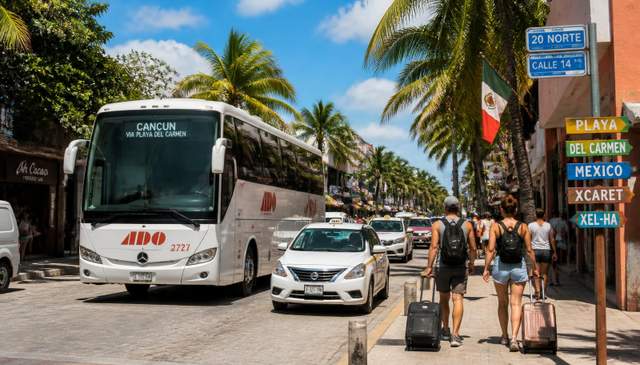
Transport can be tricky in a new country, so we have you covered. Three easy ways to get to and from Cancun airport, around town, and to our dive shop: inDrive, our trusted driver Miguel, and the ADO bus.
The Definitive Riviera Maya Travel Guide: Where to Go, Stay and Explore
The Riviera Maya is often sold as a line of resorts beside turquoise water. That description is accurate and completely inadequate.