
The Definitive Riviera Maya Travel Guide: Where to Go, Stay and Explore
The Riviera Maya is often sold as a line of resorts beside turquoise water. That description is accurate and completely inadequate.
The Riviera Maya is often sold as a line of resorts beside turquoise water. That description is accurate and completely inadequate.
Within one coastal corridor you can walk through a modern city, swim in a limestone cenote, drift over a Caribbean reef, visit a walled Maya port, cross to Cozumel, eat cochinita pibil before breakfast and travel into one of the world's most extensive flooded-cave regions. The challenge is not finding things to do. It is choosing a base and an itinerary that fit together.
This guide treats the Riviera Maya as a real region rather than a collection of isolated attractions. It explains where to stay, how to move around, which experiences deserve advance planning and how to build a trip that leaves time to enjoy the place.
Where exactly is the Riviera Maya?
The official Mexican Caribbean tourism board describes the Riviera Maya as approximately 130 kilometers of Caribbean coast running from Puerto Morelos south to Tulum. Playa del Carmen sits near its practical center, with Akumal and several resort areas between Playa and Tulum.
Travelers often use the name more loosely. Cancún is the principal northern gateway but a separate destination. Cozumel is an island reached from Playa del Carmen and makes a natural addition, especially for divers. Cobá, Valladolid and Chichén Itzá lie inland, while Sian Ka'an and Punta Allen extend the journey farther south.
This distinction is useful when calculating travel time. A hotel marketed as “Riviera Maya” might be on an isolated stretch of coast rather than inside Playa del Carmen or Tulum. Check the exact map pin before booking, particularly if restaurants, nightlife or independent day trips matter to you.
Riviera Maya at a glance
- Main international gateways: Cancún International Airport for the whole corridor; Tulum International Airport for many southern stays; Cozumel International Airport for island trips.
- Best all-round base: Playa del Carmen for travelers who want a walkable center and easy regional connections.
- Best quiet coastal town: Puerto Morelos.
- Best for resort-and-nature stays: Akumal and the coastal resort zones.
- Best for a design-led or beach-club trip: Tulum, with careful attention to its split geography and transport costs.
- Best for dive-first travel: Playa del Carmen or Cozumel, depending on whether cenotes and mainland activities matter.
- Recommended first-trip length: five to seven nights.
- Currency: Mexican peso; cards are common, but cash remains useful.
- Language: Spanish, with English widely used in established tourism businesses.
- Climate: tropical, warm year-round, with seasonal changes in rain, humidity, wind and storm risk.
When is the best time to visit?
The best month depends on what you value: comfortable weather, lower rates, fewer people, clear beach conditions or a seasonal wildlife experience.
Late November to April: generally drier and busier
This period usually brings lower humidity and more comfortable evenings. It is the easiest season for travelers who want beaches, ruins and outdoor activities without the peak summer heat. It is also the busiest and often the most expensive, especially over Christmas, New Year, spring break and Easter.
For divers, winter can combine cenotes, reefs, Cozumel and Playa del Carmen's bull shark observation season. North winds can still create rough seas and port closures. A “dry season” is a pattern, not a weather guarantee.
May to October: hotter, wetter and often better value
Expect stronger heat, higher humidity and more frequent tropical showers. Rain may arrive as a concentrated downpour rather than an entire lost day, but prolonged systems do occur. Build flexibility into boat trips and reserve cenotes, food tours or indoor options for changeable days.
The official Atlantic hurricane season runs from June 1 through November 30, according to NOAA. Most visits during those six months are not affected by a hurricane, but the financial consequences of a disruption can be serious. Choose travel insurance that covers weather-related delay or cancellation and follow official forecasts close to departure.
The sargassum question
Sargassum is floating brown algae that can accumulate on exposed Caribbean beaches. Its timing and intensity vary by year, beach, wind and current; conditions can differ significantly over a short distance and change in a day. It is therefore more useful to check recent photos and municipal monitoring than to ask whether an entire month is “safe.”
If the mainland coast is affected, alternatives include cenotes, archaeological sites, pools, town days and sometimes the western side of Cozumel. Playa del Carmen's government publishes a municipal sargassum traffic-light update, though travelers should also check their exact hotel beach.
Choosing where to stay
Puerto Morelos
Puerto Morelos is the smallest and calmest of the main coastal towns. It suits couples, families and independent travelers who want a low-rise center, a relaxed evening rhythm and access to the reef and the inland Ruta de los Cenotes. It is closer to Cancún airport than Playa or Tulum.
The tradeoff is scale. There are fewer restaurants, services and late-night options, and many “Puerto Morelos” resorts sit well outside the town. Confirm whether you are booking in the beach village, the inland colonia or an isolated resort compound.
Playa del Carmen
Playa is the region's most versatile base. Its center is walkable, the Cozumel passenger ferry leaves from downtown, intercity buses serve the city and Highway 307 connects it with the rest of the coast. Restaurants range from neighborhood taco counters to international dining, and accommodation spans hostels, apartments, boutique hotels and all-inclusive resorts.
The drawbacks are crowds, construction, nightlife noise in parts of Centro and variable beach width or sargassum. The solution is to choose the neighborhood carefully. Travelers who want the greatest range of diving—local reefs, cenotes, Cozumel, bull sharks and cave or technical training—will usually find Playa the most practical mainland base.
Akumal
Akumal is best for a quieter beach or resort stay with marine nature nearby. Much of the accommodation is in self-contained resorts and condominium developments rather than a dense town center. That can be ideal for families and travelers who intend to spend time on property.
It is less convenient for spontaneous dining, nightlife and public transport with luggage. Turtle encounters are regulated in protected zones; use authorized services, follow current access rules, maintain distance and never touch or pursue wildlife.
Tulum
Tulum combines an inland town, a coastal hotel zone and expanding residential areas. Its Maya archaeological site and proximity to southern cenotes and Sian Ka'an make it an important stop. The destination suits travelers drawn to boutique design, wellness, nightlife and beach-focused stays.
It also requires the most geographic attention. The town and beach are several kilometers apart, traffic can be slow, and taxis or daily transfers can add substantial cost. A beautiful beach hotel may be inconvenient for inexpensive meals in town; a town hotel may require daily transport to the sea. Choose based on how you will actually spend your days.
Cozumel
Cozumel is technically outside the mainland Riviera Maya, but it is the region's obvious island extension. It is a world-class dive destination with protected southern reefs, long drift dives and a slower rhythm beyond cruise-ship hours. Staying overnight benefits divers who want repeated reef days and early departures.
The compromise is mainland access. Every cenote, ruin or Playa visit requires a ferry or flight connection. A split stay—Playa first, Cozumel second—works better than repeated ferry commuting if the island is a major priority.
Cancún
Cancún is the principal air gateway and a separate destination north of the official Riviera Maya corridor. Its hotel zone offers large resorts, broad entertainment infrastructure and direct airport access. It makes sense for travelers who want a classic resort stay or have an early flight.
For a trip centered on Playa, cenotes and Tulum, moving south after arrival usually reduces daily travel. Do not choose Cancún solely because the flight lands there.
How to reach the Riviera Maya
From Cancún International Airport
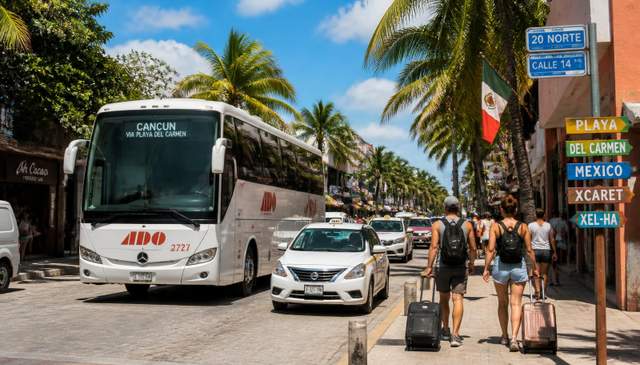
Private transfers offer the simplest door-to-door arrival, particularly for families, groups and travelers carrying dive equipment. ADO operates scheduled airport buses to Playa del Carmen and other destinations. Its current route information estimates roughly 1 hour 30 minutes to 1 hour 50 minutes from the airport to Playa, depending on terminal calls and traffic; check the live ADO airport route for schedules and fares.
Rental cars are useful for multi-stop itineraries but unnecessary for a stay focused on central Playa. Avoid accepting an unverified transport offer inside or outside the terminal. Use the provider you booked, an authorized counter or an official bus.
From Tulum International Airport
Tulum airport can be convenient for Tulum and the southern corridor. Flight routes and ground connections change, so compare the complete journey—not only airfare. A cheaper flight can lose its advantage after a long or expensive transfer to Playa or Puerto Morelos.
By Tren Maya
The Tren Maya serves stations including Cancún Airport, Playa del Carmen and Tulum. Stations are not necessarily in the pedestrian center, so include the connecting transfer in your plan. Timetables and service patterns have changed during the railway's development; use the official Tren Maya booking site for the date you need rather than copying an old schedule from a blog.
From Cozumel
Passenger ferries connect downtown San Miguel de Cozumel with central Playa del Carmen. Operators include Ultramar and Winjet. The crossing is short enough for a day trip, but sea state, queues and schedule changes make it wise to leave margin around flights and fixed appointments.
How to travel around the region
ADO buses
ADO is the most comfortable public option between airports, principal towns and some inland destinations. It is suitable for luggage and reserved seating. Terminals may not be beside your hotel, so add the final taxi or walk.
Colectivos
Shared vans run along Highway 307 and are useful for light-travel day trips between towns and roadside stops. They are inexpensive and frequent but have limited luggage space and may leave you beside a highway rather than at an attraction entrance. They suit confident independent travelers more than families carrying beach gear or divers moving equipment.
Taxis
Taxis are useful for short local trips and places away from bus routes. Confirm the price before departure or ask your accommodation to explain the current zone fare. Use authorized vehicles and keep the name or number of the unit when practical.
Rental cars
A car gives the greatest freedom for cenotes, Cobá, Valladolid and multi-hotel itineraries. Photograph the vehicle, understand the insurance, obey speed limits and watch for topes—speed bumps that may be poorly marked. Do not leave passports, electronics or luggage visible. Parking can be expensive or difficult in central Playa and the Tulum beach zone.
Organized tours
A well-designed tour is valuable when access rules, equipment, specialist interpretation or multiple transfers would be difficult independently. It is particularly sensible for scuba diving, protected wildlife encounters and first visits to remote cenotes. Compare group size, inclusions, actual time at the destination and pickup geography.
The best things to do in the Riviera Maya
Swim in a cenote
Cenotes are natural openings into the peninsula's groundwater and cave systems. Some are open pools; others are partly covered or cave-like. Activities vary by site: swimming, snorkeling, freediving and scuba diving are not interchangeable permissions.
Choose according to swimming ability, stairs, water depth, facilities and desired atmosphere. Follow each site's rules on life jackets, cameras, sunscreen and insect repellent. Many cenotes protect a freshwater resource, so a product advertised as biodegradable may still be prohibited.
Scuba dive the reefs and cenotes
Recreational divers can combine Playa del Carmen's local reefs, Cozumel drift dives and guided cenote caverns. Non-certified visitors can take a supervised Discover Scuba experience or begin an Open Water course. The detailed Playa del Carmen scuba-diving guide explains certification, site selection, seasons and sample itineraries.
Visit Maya archaeological sites
Tulum is the closest iconic site: a walled Postclassic city above the Caribbean. The official INAH Tulum record explains its role as a strategic coastal center and lists current tickets and site rules. Cobá is a much larger inland settlement linked by an extensive network of raised Maya roads. Chichén Itzá is farther away but merits a full cultural day, ideally with an early start or overnight in Valladolid.
Opening hours, ticket components, climbing rules and camera restrictions change. Check INAH immediately before travel and be cautious with sellers presenting a generic excursion as an “official” ticket.
Explore Sian Ka'an
The Sian Ka'an Biosphere Reserve protects tropical forest, mangroves, marshes, lagoons and a large marine area. UNESCO records more than 400 fish species and around 80 reef-building coral species within the property. Visit with an operator that follows reserve rules and avoids pressuring wildlife. Travel time can be significant, particularly toward Punta Allen.
Spend time on the beaches
Mainland beaches differ in access, width, facilities and exposure to waves or sargassum. Central Playa is convenient and social; Xpu-Há offers a more day-trip atmosphere; Akumal emphasizes regulated nature experiences; Tulum's coast pairs scenery with a higher-cost hotel and beach-club economy.
Mexican law establishes the beach and federal maritime zone as public domain, and federal policy requires free access. In practice, reaching the sand through resort corridors can be difficult. Use marked public access points and understand that chairs, bathrooms, parking and beach-club facilities can still have fees or minimum consumption.
Take a Cozumel day trip
Walk onto the passenger ferry from Playa for San Miguel, island restaurants, snorkeling or an independently planned day. Divers can avoid the ferry entirely on Jaguar Divers' direct Cozumel dive boat. A single day works for a taste; two or more nights are better for repeated diving and a slower island experience.
Eat beyond the resort
Try regional dishes such as cochinita pibil, relleno negro, sopa de lima and marquesitas alongside tacos, ceviche and contemporary Mexican cooking. Markets, neighborhood breakfast counters and family restaurants provide a different view of the region from resort dining.
Busy does not automatically mean safe, and expensive does not automatically mean good. Choose places with sound food handling, drink purified water and be particularly careful with raw food if you are vulnerable to gastrointestinal illness. Travelers with allergies should explain both the ingredient and the severity in Spanish when possible.
The Riviera Maya: cave-diving capital of the world
For qualified cave divers, the flooded systems beneath Quintana Roo are not a side attraction. They are a reason to cross an ocean.
The region combines huge surveyed distance with radically varied passages, clear water, generally low flow and an extraordinary concentration of road-accessible entrances. The ongoing Quintana Roo Speleological Survey documents more than 1,700 kilometers of underwater cave passage across the state. Individual system rankings change when new passages are surveyed or connections established, which is why current survey data is more useful than repeating a fixed “longest cave” claim.
It is essential to separate four activities:
- Cenote swimming: a surface recreational visit.
- Cenote snorkeling: a surface activity at sites that permit it.
- Recreational cavern diving: guided scuba within defined entrance and natural-light limits.
- Cave diving: penetration beyond the cavern zone by appropriately trained and equipped cave divers.
Technical diving may overlap with cave diving through sidemount, multiple cylinders, staged gas, decompression or rebreathers. Not every cave dive is a technical decompression dive, and not every technical diver is cave qualified. Certification must match the environment and planned procedure.
Playa del Carmen is a particularly useful specialist base. It offers accommodation at many price levels, restaurants for longer stays, access roads to northern and southern systems, dive-industry infrastructure and non-diving options for companions. Jaguar Divers provides guided cave diving and publishes sidemount, Cavern, Intro to Cave and Full Cave training. Course minimums are not promises of automatic certification; overhead skills must be earned to standard.
Riviera Maya itineraries
Three-day highlights itinerary
Day 1: Settle into Playa del Carmen, walk the center and choose a calm beach period rather than scheduling a distant excursion after a flight.
Day 2: Visit Tulum early, then add one nearby cenote if the timing and heat allow.
Day 3: Choose Cozumel, a reef trip or a full cenote day according to your interests. Do not attempt all three.
Five-day beach, cenote and culture itinerary
Day 1: Arrival and local orientation.
Day 2: Beach morning and Playa food or neighborhood exploration.
Day 3: Guided cenote day.
Day 4: Tulum archaeological site and a slower afternoon.
Day 5: Cozumel day trip or Sian Ka'an experience.
Seven-day balanced itinerary
Use Playa as the base for four nights, with one local day, one cenote day and one Cozumel day. Move south for two or three nights near Tulum or Akumal for the archaeological site, Sian Ka'an and a quieter beach day. Preserve one flexible day for weather, rest or the activity you discover after arrival.
Ten-day slow-travel itinerary
Stay rather than commute: three or four nights in Playa, two nights on Cozumel, two or three nights in the southern corridor and one or two nights in Valladolid for Chichén Itzá or nearby Yucatán experiences. The extra check-ins are justified because they remove repeated long transfers.
Seven-day cave and technical diving itinerary
Day 1: Arrival, equipment assembly and rest.
Day 2: Configuration and skills assessment in a suitable environment.
Days 3–4: Progressive guided caves or the opening days of formal training.
Day 5: Rest, equipment maintenance or a cultural day.
Days 6–7: Further cave dives or training selected from demonstrated performance, followed by adequate no-fly time.
This is a framework, not a route list. The instructor or guide should choose systems for certification, configuration, experience, recent diving and team objective.
What will a Riviera Maya trip cost?
The largest variables are accommodation location and transport style. A traveler in central Playa can walk to meals and use buses or colectivos for many trips. A beachfront Tulum stay may involve premium room rates, taxis and higher restaurant prices. An isolated all-inclusive can make daily spending predictable but raises the cost of independent exploration.
Build a budget in these categories:
- accommodation, including taxes and resort fees;
- airport transfers and local transport;
- food outside any meal plan;
- archaeological and protected-area admissions;
- beach-club or parking costs;
- tours and guide services;
- scuba diving, equipment and site fees;
- travel insurance;
- tips and a contingency fund.
Quote and pay in the currency stated by the provider. If a business prices in US dollars, ask which exchange rate applies when paying in pesos. Use bank-affiliated ATMs, decline unnecessary dynamic currency conversion when your home bank offers a better rate and notify your bank of travel if required.
Practical travel information
Cash and cards
Cards are widely accepted in hotels and established restaurants, but cash helps with colectivos, tips, smaller eateries, parking and occasional site fees. Carry modest amounts rather than a large visible roll. Mexican pesos are the simplest currency for day-to-day travel.
Drinking water
Do not drink untreated tap water. Hotels and rentals normally supply purified water, and restaurants use purified ice in established tourist areas. If you are uncertain, ask. Carry oral rehydration supplies and seek medical advice for severe or persistent symptoms.
Mobile data
Check whether your home plan includes Mexico. An eSIM or local SIM can be useful for maps, transport communication and booking changes. Download offline maps before remote day trips because coverage can weaken away from towns.
Electricity
Mexico uses 127V, 60Hz electricity and mainly Type A and B plugs. Travelers from the United States and Canada generally need no plug adapter; visitors from many other countries do. Confirm whether heat-producing devices support the voltage.
Entry requirements and taxes
Passport, visa and immigration rules depend on nationality and can change. Check the Mexican consulate or official guidance before travel. Quintana Roo also operates a visitor tax for many international travelers; use the official channel and verify the current rule rather than paying through an unsolicited link.
Insurance and health
Buy insurance that covers your itinerary, medical treatment and evacuation. Standard policies may exclude scuba depth, cave diving, technical diving, motorcycles or high-risk activities. If diving, consider specialist membership or coverage for recompression treatment and evacuation.
Safety and common tourist problems
Millions of visitors travel through the region, but it is not sensible to describe any destination as risk-free. Current government advisories should form part of planning; the U.S. State Department, for example, advises increased caution in Quintana Roo and emphasizes awareness after dark and use of well-lit tourist areas.
Use ordinary urban precautions: keep phones and wallets secure, avoid displaying valuables, use authorized transport, do not buy illegal drugs and remain aware late at night. Leave passports in secure accommodation unless the day's activity requires them, and carry an appropriate copy or alternative identification.
At the beach, follow warning flags and avoid swimming in rough water. Heat and dehydration cause problems more often than dramatic hazards: use shade, protective clothing and regular water. On the road, avoid impaired driving and give yourself more time than the map suggests.
Mexico's national emergency number is 911. Save your insurer, accommodation, transport provider and relevant embassy contact before travel.
Responsible travel
The cenotes are part of the region's aquifer, not theme-park pools. Shower when required, follow restrictions on chemicals, keep out of closed passages and never touch formations. Qualified divers should use precise buoyancy and propulsion to avoid sediment and damage.
On reefs, maintain neutral buoyancy, do not stand on coral and do not chase or touch wildlife. Choose observation over baiting or staged contact. In protected areas such as Cozumel and Sian Ka'an, use authorized providers and pay required fees that support management.
Reduce disposable plastic, refill water containers where safe, choose local independent businesses as part of the trip and respect residential streets beyond the visitor zones. Maya culture is living culture; archaeological sites are not the only places where it exists.
Mistakes to avoid
- Booking a “Riviera Maya” hotel without checking its exact location.
- Changing hotels every night instead of grouping the region geographically.
- Treating Cancún, Playa del Carmen, Akumal and Tulum as adjacent neighborhoods.
- Assuming sargassum conditions are identical along the whole coast.
- Planning a flight immediately after the final scuba day.
- Entering a cave passage with only recreational scuba training.
- Building every day around a distant excursion and leaving no time for the chosen base.
- Trusting an old train, bus, ferry or attraction schedule.
- Underestimating heat at archaeological sites.
- Choosing wildlife activities without checking how animals are approached.
Build the trip around your real priorities
The Riviera Maya works best when you decide what the trip is primarily about. If it is food and walkability, stay centrally. If it is a quiet resort, accept that spontaneous exploration may require transport. If it is diving, choose a base and no-fly plan before buying tours. If it is cave training, let the course determine the calendar rather than squeezing it between nightlife and a departure flight.
For help integrating local reefs, cenotes, Cozumel, recreational courses or specialist cave diving into a wider itinerary, contact Jaguar Divers. Share certification, logged dives, last dive date, available days, party size and preferred environments so the diving fits the trip rather than consuming it.
Sources and fact-check record
This guide was checked on September 2, 2026. Transport schedules, fees, access rules and wildlife conditions can change and should be checked again before publication or travel.
- Mexican Caribbean Tourism Board: Riviera Maya
- Mexican Caribbean Tourism Board: Playa del Carmen
- ADO: Cancún Airport to Playa del Carmen
- Official Tren Maya booking site
- INAH: Tulum archaeological site
- INAH: Cobá archaeological site
- UNESCO World Heritage Centre: Sian Ka'an
- SEMARNAT: Free public beach access
- NOAA: Tropical Cyclone Climatology
- Quintana Roo Speleological Survey
- Jaguar Divers: Guided Cave Diving
- U.S. Department of State: Mexico Travel Advisory
Related articles
The Complete Playa del Carmen Travel Guide: Beaches, Things to Do and Local Tips
Playa del Carmen succeeds because it is not only a resort. It is a beach destination, a transport hub and a working Caribbean city in the same compact place.
The Ultimate Guide to Scuba Diving in Playa del Carmen
Playa del Carmen is one of the rare dive destinations where a single hotel can put you within reach of warm Caribbean reefs, freshwater cenotes, Cozumel's famous walls, seasonal bull sharks and some of the most important flooded caves on Earth.
Getting Around Playa del Carmen: Transport Guide
Transport can be tricky in a new country, so we have you covered. Three easy ways to get to and from Cancun airport, around town, and to our dive shop: inDrive, our trusted driver Miguel, and the ADO bus.