
What Makes Cenote Diving Different from Ocean Diving?
If you are already a certified diver and you are planning a trip to Playa del Carmen, Tulum, or the Riviera Maya, cenote diving is probably one of the experiences you keep hearing about. And for good reason. Cenotes are not just…
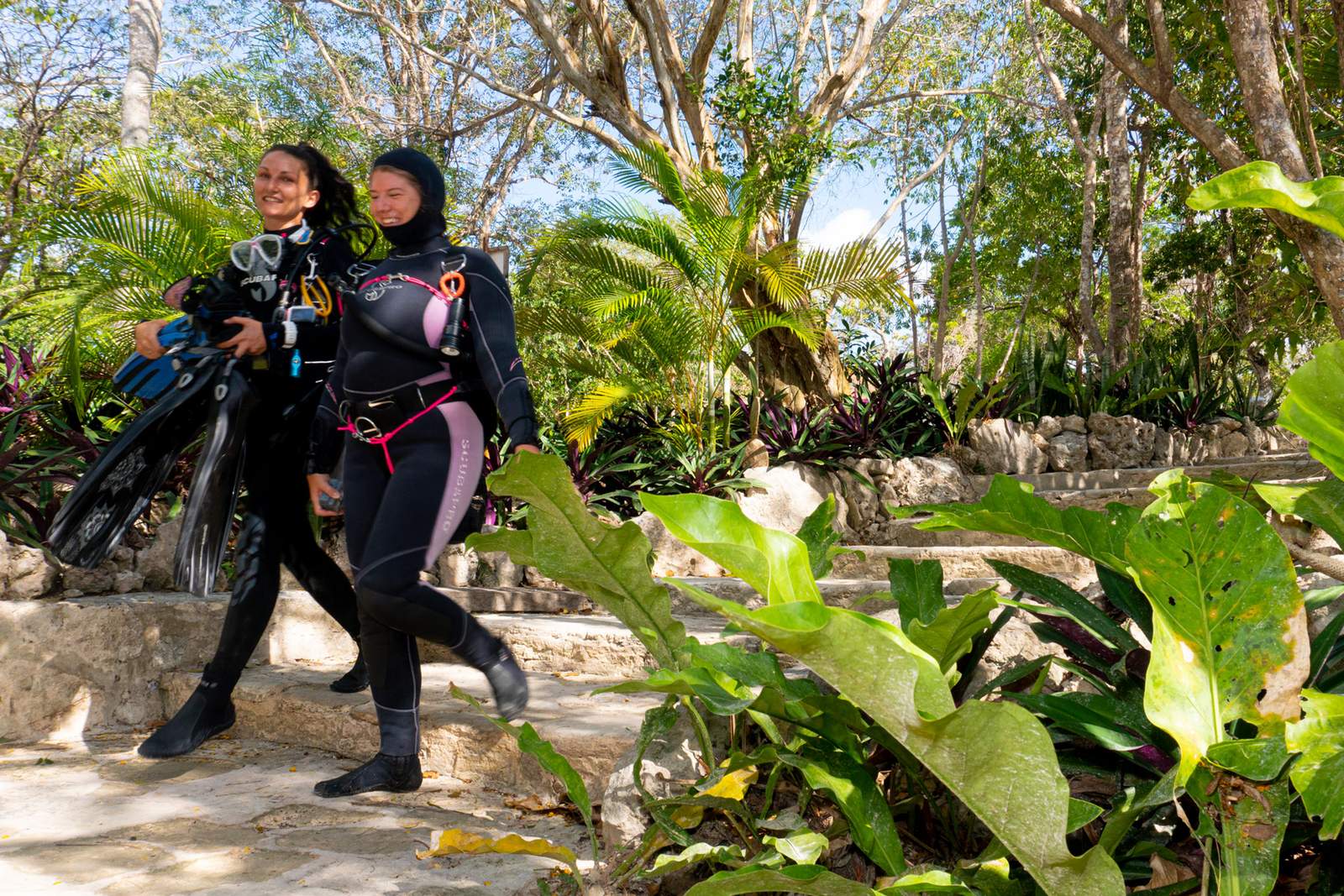
If you are already a certified diver and you are planning a trip to Playa del Carmen, Tulum, or the Riviera Maya, cenote diving is probably one of the experiences you keep hearing about. And for good reason. Cenotes are not just “another dive site.” They are part of a completely different underwater world: clear freshwater, limestone formations, dramatic light beams, quiet caverns, and an atmosphere that feels far removed from a typical reef or ocean dive.
But cenote diving is also often misunderstood.
Some divers imagine it as full cave diving, only for technical divers with advanced training. Others think it is just like diving in a lake, but with prettier scenery. The truth sits somewhere in between. Recreational cenote diving for certified divers is usually conducted as cavern diving, not full cave diving. That means you stay within limits appropriate for recreational divers, with a trained guide, a continuous guideline, natural light zones, and strict safety procedures.
So, what actually makes cenote diving different from ocean diving?
Let’s break it down carefully.
1. You Are (Mostly) Diving in Freshwater, Not Saltwater
The first difference you will feel is the water itself.
Most ocean dives in the Riviera Maya, Cozumel, or Playa del Carmen are saltwater dives. Cenotes, by contrast, are usually freshwater systems connected to the underground aquifer of the Yucatán Peninsula. The region is known for its extensive karst aquifer system, which is one of the most remarkable limestone groundwater systems in the world.
Freshwater affects your buoyancy. Because freshwater is less dense than saltwater, you normally need less weight than you would use in the ocean. This is important. If you enter a cenote with the same weighting you use for ocean diving, you may be overweighted, which makes buoyancy control harder and increases the risk of stirring up sediment.
Good guides will check your weighting and help you adjust before the dive. But as a certified diver, it is useful to understand the difference before you arrive. Cenote diving rewards calm, precise buoyancy. The goal is not to fight the water. The goal is to move slowly, stay balanced, and avoid disturbing the environment.
2. Visibility Can Be Exceptionally Clear
Many divers describe cenote visibility as surreal. In some cenotes, the water can be so clear that you may feel as if you are floating in air. There are no waves, no sand being pushed around by surf, and often very little suspended matter in the water.
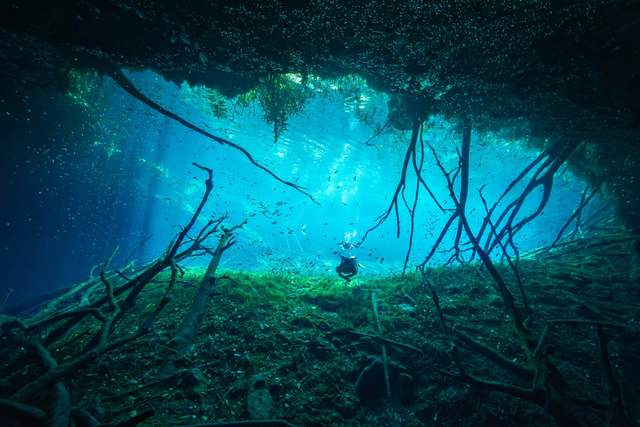
This creates an extraordinary visual experience. You can see limestone formations, tree roots, rock textures, cavern openings, and other divers with impressive clarity.
However, that clarity comes with responsibility. Cenotes can have areas with very fine sediment. If a diver kicks badly, drops a knee, drags a fin, or swims too close to the bottom, that sediment can rise quickly and reduce visibility. This is called a silt-out. In a cavern environment, even a partial loss of visibility is taken seriously.
That is why good trim and propulsion matter so much in cenotes. You do not need to be a technical diver, but you do need to dive with control. Slow frog kicks, modified flutter kicks, and awareness of your fin position are far more useful than strong, wide kicks.
3. There Are No Waves, Surge, or Typical Ocean Current
Ocean diving is dynamic. Depending on the site, you may deal with waves at the surface, surge near reefs, changing currents, boat traffic, or drift conditions. In Cozumel, for example, drift diving is part of the experience. You let the current carry you over the reef while your guide manages the route.
Cenote diving feels completely different.
Inside a cenote, the water is generally calm. There is no surface chop once you descend, no reef surge pushing you back and forth, and no ocean swell moving your body. This gives the dive a very peaceful feeling.
But calm does not mean casual. Because you are often entering a cavern zone, the safety mindset changes. In the ocean, if something goes wrong, you may be able to ascend directly to the surface. In a cenote cavern, you may have a ceiling above part of your route. That means you follow the guide, stay on the planned path, respect gas management rules, and avoid entering any area beyond your training.
4. Cenote Diving Is Usually Cavern Diving, Not Cave Diving
This is one of the most important distinctions.
A cavern dive is not the same as a cave dive. Recreational cenote dives are normally conducted in the cavern zone, where divers remain within limits such as natural light, a marked route, and access to an exit under the supervision of a qualified guide. Cavern training agencies commonly emphasize the daylight zone and overhead-environment procedures as defining features of cavern diving.
Full cave diving is different. It requires specialized training, equipment, procedures, and experience. Certified recreational divers should not enter cave passages or go beyond the cavern limits unless they are properly cave trained.
This is where choosing the right dive center matters. A professional cenote guide will give a detailed briefing, explain the route, review hand signals, check equipment, monitor gas, and make sure the group stays within safe recreational limits.
As a diver, your role is simple: follow the guide, stay close, maintain buoyancy, avoid touching anything, and never leave the line or route.
5. The Overhead Environment Changes the Safety Mindset
In the ocean, most recreational dives are open-water dives. That means there is usually direct vertical access to the surface.
In cenote diving, part of the route may pass under a cavern ceiling. This is called an overhead environment. Even when the dive is recreational and within cavern limits, this changes how divers should think.
You are not there to improvise. You are there to follow a plan.
Before the dive, your guide should explain:
- the entry and exit points
- the maximum depth
- the route
- gas management
- emergency procedures
- light use
- positioning within the group
- what to do if visibility is reduced
- what to do if a diver has a problem
This may sound serious, and it should. But it should not sound frightening. Cenote diving is beautiful precisely because it is done with discipline. When the procedures are followed, the experience can feel calm, controlled, and deeply enjoyable.
6. Light Beams Become Part of the Dive
One of the most memorable differences between cenote and ocean diving is the light.
On a reef, sunlight spreads through the water column and illuminates coral, fish, sand, and blue water. In a cenote, light often enters through specific openings in the rock or jungle canopy. That creates beams, curtains, reflections, and sharp contrasts between light and shadow.
This is one of the reasons cenote dives feel so cinematic.
Depending on the cenote, the season, the time of day, and the weather, the light show can change dramatically. Some cenotes are famous for wide columns of sunlight. Others are darker, moodier, and more focused on formations, tunnels, or room-like chambers.
This also means that two dives in the same cenote can feel different depending on conditions. A sunny day and a cloudy day do not create the same atmosphere.
7. The Scenery Is Geological, Not Coral-Based
Ocean dives in the Mexican Caribbean often focus on marine life, coral formations, sponges, reef structure, turtles, rays, fish schools, or bull sharks depending on the season and location.
Cenote diving is different. The main attraction is geological.
You are diving through limestone formations shaped over long periods of time. Cenotes are natural openings into underground water systems, often formed where limestone bedrock and cave ceilings have collapsed or eroded, exposing groundwater below.
Instead of coral heads and reef walls, you may see:
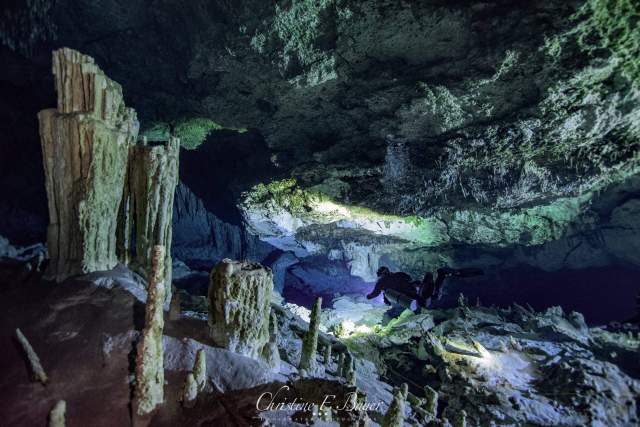
- stalactites
- stalagmites
- columns
- limestone decorations
- collapsed rock
- tree roots reaching into the water
- haloclines in some sites
- hydrogen sulfide clouds in specific deeper cenotes
- ancient cavern passages
This is why cenote diving often feels quieter and more contemplative than ocean diving. It is less about chasing marine life and more about observing space, light, structure, and silence.
8. Marine Life Is Usually Not the Main Attraction
If your main goal is to see large marine animals, coral reefs, turtles, rays, or big schools of fish, the ocean is usually the better choice.
Cenotes can have life, but it is generally more subtle. Depending on the site, you may see small freshwater fish, catfish, blind cave-adapted species in some systems, turtles near open areas, or plant life around the entrance. But cenote diving should not be sold as a wildlife dive.
The magic of cenotes is not “how many animals will I see?” The magic is the environment itself.
This matters for expectations. A diver who expects a reef dive may not understand cenotes at first. But a diver who enjoys landscapes, geology, light, silence, and precision often finds cenote diving unforgettable.
9. Buoyancy and Trim Matter More Than Ever
You do not need to be perfect to dive cenotes, but you do need to be stable.
Good buoyancy is important in every dive. In cenotes, it becomes essential because the environment is fragile and because visibility can be affected by poor technique. If your fins are constantly dropping, if you bicycle kick, or if you rely on your hands to move, you may disturb the bottom or accidentally touch formations.
A good cenote diver moves slowly. They stay horizontal. They keep their fins away from the floor and walls. They breathe calmly. They avoid sudden movements.
This is one of the reasons many divers say cenote diving makes them better divers. It forces you to become more aware of your position in the water. You start noticing your breathing, your kick, your distance from the guide, your body angle, and your impact on the environment.
10. The Briefing Is More Detailed Than a Typical Reef Briefing
Before an ocean reef dive, a briefing may cover the dive site, depth, current, marine life, boat procedures, air pressure rules, and safety signals.
Before a cenote dive, the briefing is usually more detailed. It needs to be.
Your guide should explain not only where you are going, but how you will move through the site. You may discuss single-file positioning, light signals, turn pressure, lost diver procedures, lost visibility procedures, and environmental protection rules.
This is not just formalism. In cenote diving, the briefing creates the structure that makes the dive safe and enjoyable.
Listen carefully. Ask questions before entering the water. If something is unclear, clarify it on land. Once you are underwater, the dive should feel calm because the plan is already understood.
11. The Equipment Setup May Be Slightly Different
For recreational cenote dives, you do not need full technical cave equipment. However, there are some differences compared with a normal ocean dive.
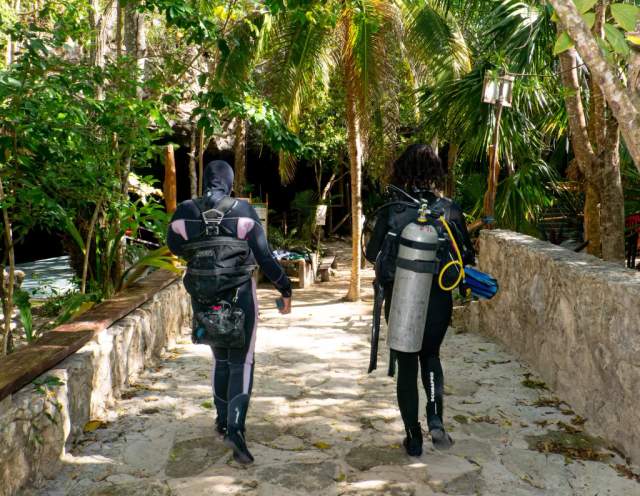
You will usually carry a dive light, even if the route includes natural light. Your guide may carry multiple lights and other safety equipment. Depending on the operation and dive site, tank configuration, weighting, exposure protection, and accessories may be adjusted.
Exposure protection is also worth considering. Cenote water is often cooler than Caribbean ocean water. Many divers are comfortable in a 5 mm wetsuit, but this depends on the diver, the cenote, the number of dives, and personal cold tolerance.
The key is not to overcomplicate things. For certified recreational divers, the most important “equipment” is still good buoyancy, calm breathing, and attention to the guide.
12. Cenote Diving Feels More Mental Than Physical
Ocean dives can sometimes feel energetic: entries, exits, waves, current, boat movement, surface swims, and active reef navigation.
Cenote diving is usually less physically demanding in that sense. But it can feel more mental.
The overhead environment, darker areas, silence, and enclosed rock formations can make some divers more aware of their breathing and comfort level. This is normal. It does not mean you are not ready. It simply means cenote diving is a different sensory experience.
The best approach is to start with a beginner-friendly cenote route if it is your first time. Choose a dive center that does not rush you, keeps groups small, and matches the dive to your level.
You should never feel pushed into a cenote that is beyond your comfort zone.
13. Not All Cenotes Are the Same
This is another important point.
Saying “I want to dive a cenote” is like saying “I want to dive in an ocean.” There are many different types of cenote dives.
Some are bright and open. Some are shallow and relaxed. Some are darker and more atmospheric. Some have dramatic formations. Some are deeper. Some are better for first-time cenote divers. Others are better suited to advanced divers with excellent buoyancy and comfort in overhead environments.
That is why the best cenote for you depends on your certification, experience, buoyancy, comfort level, and what kind of experience you want.
A new Open Water diver with good control may enjoy a different site than an experienced Advanced Open Water diver looking for depth, haloclines, or more dramatic scenery.
14. Cenote Diving Is About Respect
Cenotes are not artificial dive sites. They are natural, cultural, geological, and ecological spaces. For Maya communities, cenotes have long held cultural and spiritual significance, and they remain important freshwater sources for communities and ecosystems today.
That means divers should approach them with respect.
Do not touch formations. Do not take anything. Do not leave anything. Do not use sunscreen or chemicals before entering if the site rules prohibit it. Do not kick the bottom. Do not treat the cenote like a swimming pool.
The best cenote divers are quiet guests. They enter carefully, dive gently, and leave no trace.
15. So, Is Cenote Diving Right for You?
If you are a certified diver with decent buoyancy, an open mind, and a willingness to follow procedures, cenote diving can be one of the most memorable dive experiences in Mexico.
It is not the same as reef diving, and it should not be treated the same way. There are fewer fish, no coral gardens, no waves, and no blue-water drift. Instead, you get silence, freshwater clarity, limestone architecture, light beams, and the feeling of entering a hidden part of the planet.
For many divers, cenotes become the highlight of their trip.
The best advice is simple: choose the right cenote for your level, dive with a professional guide, listen carefully to the briefing, move slowly, and respect the environment.
Cenote diving is not about going fast or far. It is about control, awareness, and wonder.
And when it is done properly, it is unlike anything else in recreational scuba diving.
Frequently asked questions
Do I need to be certified to dive in cenotes?+
Is cenote diving the same as cave diving?+
Is cenote diving safe for Open Water divers?+
What is the biggest difference between cenote diving and ocean diving?+
Will I see many fish or marine animals in cenotes?+
Do I need special equipment for cenote diving?+
Are cenotes dark inside?+
What certification level is best for cenote diving?+
Can beginners dive in cenotes?+
Why is buoyancy so important in cenote diving?+
Related articles
What to Expect on a Full Day Cenote Diving Trip from Playa del Carmen
A full day of cenote diving from Playa del Carmen is one of the easiest ways to experience the underground world of the Riviera Maya without needing to be a cave diver. You leave the town, drive into the jungle, gear up beside a…
The Best Cenote Diving Routes for First-Time Cavern Divers
For many certified divers visiting the Riviera Maya, cenote diving is the experience they are most curious about — and sometimes the one they feel most unsure about. That makes sense. Cenotes are not ocean dives. They are…
Cavern Diving vs. Cave Diving: What Recreational Divers Need to Know Before Diving Cenotes
Cenote diving is one of the main reasons certified divers travel to Playa del Carmen, Tulum, and the Riviera Maya. The water is clear, the limestone formations are beautiful, and the atmosphere is completely different from ocean…