
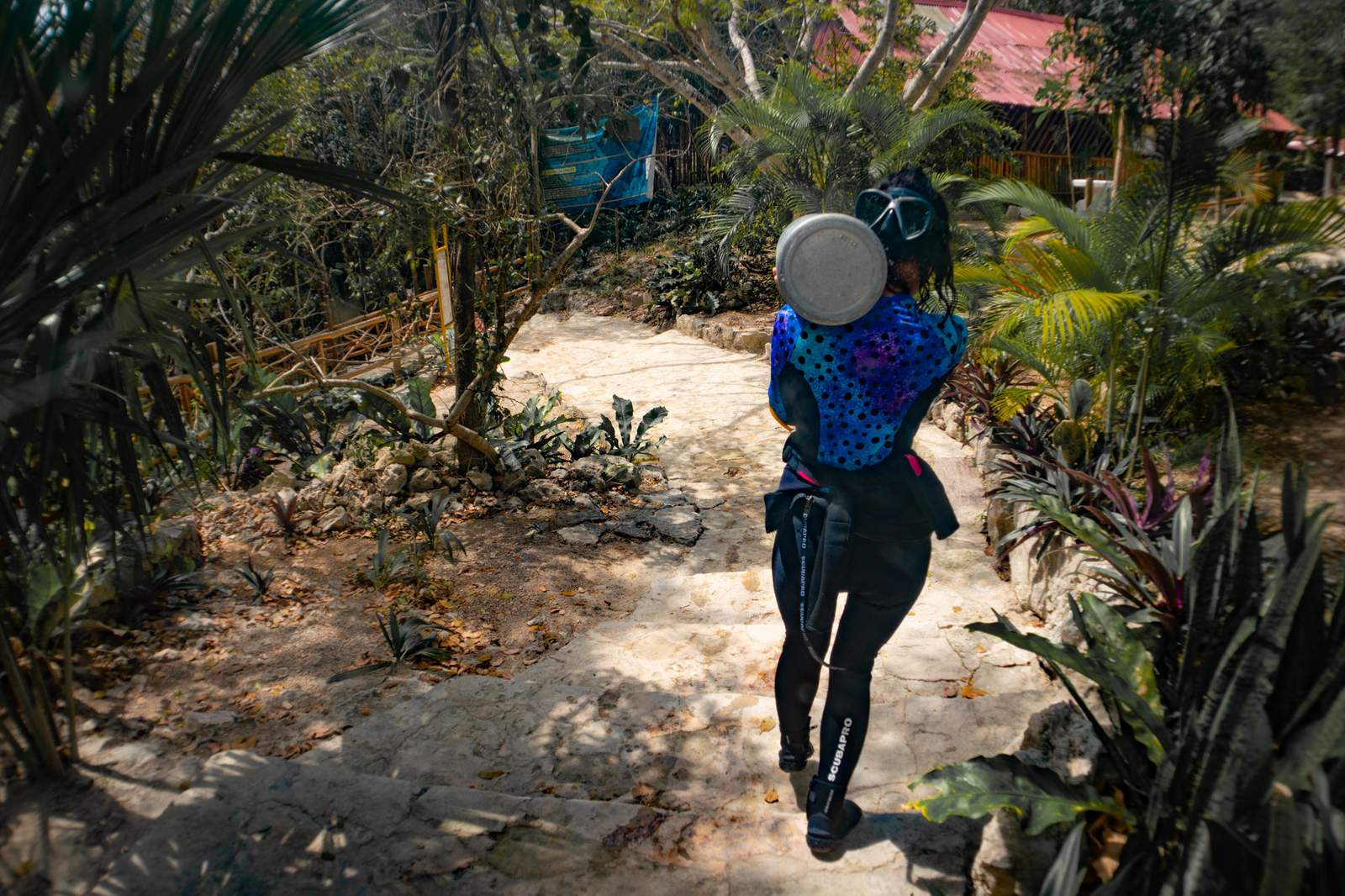
How to Choose the Right Cenote Dive for Your Certification Level
Choosing the right cenote dive is not just about picking the most famous name. It is about choosing a dive that fits your certification, experience, buoyancy, comfort level, and mindset. This matters because cenote diving is…
Choosing the right cenote dive is not just about picking the most famous name.
It is about choosing a dive that fits your certification, experience, buoyancy, comfort level, and mindset. This matters because cenote diving is different from ocean diving. You may be in freshwater instead of saltwater. You may have a ceiling overhead for part of the route. You may follow a guideline through a cavern zone. You may be diving in very clear water where one bad fin kick can reduce visibility for everyone behind you.
A cenote can be peaceful, beautiful, and beginner-friendly. Another cenote can be deep, dark, fragile, or psychologically demanding. Both can be amazing, but they are not right for the same diver.
The mistake many divers make is asking, “What is the best cenote?”
The better question is: what is the best cenote for my current level?
This guide will help you understand how to choose the right cenote dive based on your certification and real ability, not just the card in your wallet.
Your Certification Is the Starting Point, Not the Whole Answer
Your certification level matters. It sets basic depth and training limits. For example, PADI says newly certified Open Water Divers are trained to dive to a maximum of 18 meters / 60 feet, or to the depth reached during training if that was shallower. PADI Advanced Open Water Diver qualifies divers to dive to 30 meters / 100 feet, while diving to the recreational limit of 40 meters / 130 feet requires additional deep-diving training and experience.
But certification alone does not tell the whole story.
An Open Water diver with 80 recent dives, excellent buoyancy, and calm breathing may be more prepared for a beginner-friendly cavern route than an Advanced Open Water diver who has not dived for three years. A diver can have an advanced card and still be nervous in darker spaces. Another diver may be technically allowed to dive to 30 meters but have poor air consumption or weak buoyancy.
So, when choosing a cenote, think about three things:
Your certification limit — how deep and what type of environment you are trained for.
Your actual experience — how many dives you have, how recent they are, and where you have dived.
Your in-water control — buoyancy, trim, finning, breathing, awareness, and comfort.
A good dive center should ask about all three.
Cavern Diving Is Not the Same as Cave Diving
This distinction is essential.
Most recreational cenote dives are cavern dives, not full cave dives. Cavern diving stays within recreational limits and within the natural light zone. Cave diving goes beyond that and requires specialized cave-diving training, equipment, procedures, and experience.
PADI describes its Cavern Diver course as training divers to explore caverns while staying within the light zone for an easy exit to open water. The course itself requires Advanced Open Water Diver certification and a minimum age of 18.
That does not mean every guided recreational cenote diver needs a Cavern Diver certification. Many guided cenote dives are conducted for certified recreational divers under professional supervision. But it does mean you should understand the boundary.
If you are not cave trained, do not enter cave passages. Do not swim beyond the guide. Do not leave the route. Do not follow a tunnel because it looks interesting. In cenote diving, curiosity must stay inside the limits of training.
For Newly Certified Open Water Divers
If you are newly certified, your best cenote choices should be shallow, open-feeling, bright, and forgiving. You want a site that allows you to enjoy the freshwater environment without adding too much psychological pressure.
Good options may include cenotes such as Casa Cenote or Garden of Eden, depending on conditions and the exact route chosen by the dive center. These sites can offer a more open, relaxed introduction to cenote diving compared with darker or more enclosed cavern routes. Garden of Eden, also known as Cenote Ponderosa, is commonly treated as an Open Water-level dive, and Jaguar Divers lists it with a maximum depth of around 15 meters / 50 feet.
For newer divers, the goal is not to do the most dramatic cenote. The goal is to build comfort.
You should choose a beginner-friendly cenote if:
- you have fewer than 20 logged dives
- you have not dived in several months
- you are still working on buoyancy
- you are unsure how you will feel in an overhead environment
- you use your hands a lot underwater
- your air consumption is high
- you get anxious in low light or enclosed spaces
There is no shame in starting easy. In fact, it is the smartest way to start.
A first cenote dive should leave you thinking, “That was amazing — I want to do more,” not “I survived that.”
For Confident Open Water Divers
If you are Open Water certified but have good buoyancy, recent dives, and a calm attitude underwater, you may have more options.
This is where cenotes such as Chac Mool, Kukulkán, Chikin Ha, Garden of Eden, or Dos Ojos Barbie Line may become appropriate, depending on the dive center, conditions, and guide judgment.
These routes can introduce you to the real feeling of cavern diving: following a line, moving through light and shadow, controlling your fins near rock and sediment, and staying close to the guide. They are not “technical” dives when conducted properly within recreational cavern limits, but they do require respect.
A confident Open Water diver should still avoid choosing based on ego. Do not think, “I’m certified, so I can dive anything under 18 meters.” Depth is only one part of the decision.
Some cenotes are not deep but can still feel demanding because they are darker, more enclosed, more fragile, or more sensitive to poor buoyancy. A shallow cenote with delicate formations can be less forgiving than a deeper open-water reef.
For this level, the best question to ask your dive center is:
“Which cenote gives me a real cavern experience without being too deep, dark, or tight for my first time?”
That question tells the operator you want a proper experience, but you are not trying to jump ahead too fast.
For Advanced Open Water Divers
Advanced Open Water certification opens more possibilities, especially for deeper cenotes or routes where the main feature sits below Open Water limits.
Examples may include The Pit or Angelita, both of which are often treated as advanced cenote dives because of depth and environmental complexity. Triton Diving describes The Pit as requiring at least Advanced Open Water or equivalent due to recreational dive depths up to around 30 meters and the complexity of the environment. Blue Life describes Angelita as a deep dive where their dive depth is limited to 30 meters, with the hydrogen sulfide cloud around that depth, and states that Advanced Open Water certification is required for their Angelita dives.
But again, the advanced card is not magic.
For advanced cenotes, you should be comfortable with:
- deeper profiles
- faster gas consumption at depth
- shorter no-decompression limits
- more careful descent and ascent control
- possible narcosis awareness
- stricter gas management
- darker or more atmospheric environments
- following a plan without improvising
An Advanced Open Water diver who has only done the course dives and then stopped diving should not automatically go to The Pit or Angelita. Those dives are best for divers who are recent, calm, and comfortable managing depth.
Advanced cenotes are not only “more beautiful.” They are more serious.
For Deep Diver Specialty or Very Experienced Recreational Divers
If you have a Deep Diver specialty, strong experience, and excellent control, you may be eligible for deeper recreational cenote profiles, depending on the operator and local rules.
This does not mean every deep cenote is appropriate. It simply means you may have the training background for routes that go beyond standard Advanced Open Water depth, where allowed and properly guided.
The key issue becomes judgment.
At depth, small problems become more important. Gas is used faster. Narcosis may become more noticeable. No-decompression time is shorter. Ascent control matters more. In a cenote, you may also be dealing with darkness, visual illusions, haloclines, hydrogen sulfide layers, or overhead-zone procedures.
A deep cenote dive should feel planned, not casual.
If the briefing is vague, the group is too large, or the operator does not ask about your experience, that is a warning sign.
For Rescue Divers
Rescue Diver certification does not necessarily increase your depth limit, but it does improve your awareness. That can be very valuable in cenote diving.
Rescue-trained divers often think more clearly about stress, buddy awareness, prevention, and early problem recognition. In cenotes, that mindset is useful. You are not just looking at scenery. You are watching your position, your breathing, your guide, your buddy, your gas, your buoyancy, and the environment.
However, Rescue certification is not a substitute for cavern or cave training. It does not qualify you to leave the recreational cavern route or enter cave passages.
For a Rescue Diver, cenote selection should still be based on depth, buoyancy, comfort, recency, and overhead environment.
For Cavern-Certified Divers
If you have a Cavern Diver certification, you have a stronger foundation for overhead-environment awareness, line protocols, light use, gas rules, and emergency procedures.
That is valuable.
However, a Cavern Diver certification still has limits. It is not a full cave-diving certification. You still remain within cavern limits, usually the natural light zone, and you do not treat cave passages as open territory.
In the Riviera Maya, some cavern-certified divers may want more challenging guided cavern routes, while others may use the certification as a stepping stone toward Intro to Cave or Full Cave training.
The important point is to be honest about your current skill level. A cavern certification from several years ago, followed by no overhead dives, should not be treated the same as recent, active cavern experience.
For Cave Divers
If you are cave certified, your decision-making becomes much more specific. You are no longer simply choosing a recreational cenote tour. You are choosing cave systems, lines, navigation plans, gas strategy, equipment configuration, team protocols, and training-appropriate objectives.
This article is mainly for recreational divers, so the main advice here is simple: dive with a professional cave operation that understands your certification level, verifies your experience, and plans dives within your training limits.
A cave card is not permission to dive any cave. Cave diving requires discipline, currency, and humility.
Why “Level 1, Level 2, Level 3” Can Be Useful — But Not Universal
In the Riviera Maya, many operators use level systems to classify cenotes. A Level 1 cenote usually means easier, shallower, brighter, or more beginner-friendly. Higher levels may involve deeper profiles, more darkness, more fragile areas, more complex navigation, or stronger psychological demands.
This system can be helpful, but it is not globally standardized. One dive center’s level system may not match another’s exactly.
So, instead of relying only on the label, ask what the level actually means.
Ask:
How deep is the dive?
Is there an overhead section?
How much natural light is visible?
Is the route narrow or spacious?
Is the bottom silty?
Are there delicate formations?
What certification and experience do you require?
How many divers are in the group?
Those answers matter more than the label.
Match the Cenote to Your Weakest Skill
This is one of the most practical rules in cenote diving.
Do not choose a cenote based on your strongest skill. Choose it based on your weakest skill.
If you are certified Advanced Open Water but your buoyancy is weak, choose an easier cenote. If you are comfortable with depth but nervous in darkness, do not start with a darker cavern. If you have good buoyancy but have not dived recently, do a gentler route first. If your air consumption is high, avoid dives where gas management is more demanding.
Cenote diving exposes weak habits quickly.
Bad trim becomes obvious. Poor finning becomes obvious. Overweighting becomes obvious. Anxiety becomes obvious. Camera distraction becomes obvious.
That is not a bad thing. Cenotes can make you a better diver. But you should not use a fragile overhead environment as the place to discover problems you could have addressed earlier.
The Best Cenote Choice by Diver Type
For a new or nervous Open Water diver, start with something open, shallow, and bright. Casa Cenote or Garden of Eden may be better choices than a darker cavern route.
For a comfortable Open Water diver with decent buoyancy, consider beginner-friendly cavern routes such as Chac Mool, Kukulkán, Chikin Ha, Garden of Eden, or Dos Ojos Barbie Line, depending on the operator’s assessment.
For a confident diver who has done at least one easy cenote, Tajma Ha may be a good next step if the diver has stable buoyancy and is comfortable with a more atmospheric cavern feel.
For an Advanced Open Water diver with recent experience, deeper sites such as The Pit or Angelita may be appropriate when guided properly and when the diver is comfortable with depth.
For a photographer, choose based on buoyancy first, camera second. A GoPro or small camera is usually more appropriate for early cenote dives than a large rig. No photo is worth damaging formations or silting out the group.
For a rusty diver, do not start with an ambitious cenote. Do a refresher, a shallow ocean dive, or a very easy cenote first. Being honest here makes the whole experience better.
Questions to Ask Before Booking
Before booking a cenote dive, ask your dive center a few direct questions.
“What certification do you require for this cenote?”
“What is the planned maximum depth?”
“How many divers are in the group?”
“Is this suitable for a first cenote dive?”
“How much cavern overhead is involved?”
“Do you recommend this route for someone with my experience?”
“What happens if I feel uncomfortable during the dive?”
“Do I need Advanced Open Water for this route?”
“Is good buoyancy required, or is the route forgiving?”
“Will I be carrying a light?”
A good operator will answer clearly. They will not make you feel silly for asking. They will not push you into a dive that does not match your level.
In fact, the best dive centers are often conservative. That is a good sign.
Red Flags When Choosing a Cenote Dive
Be careful if an operator says every cenote is suitable for everyone.
Be careful if they do not ask about your certification, last dive, number of dives, or comfort level.
Be careful if the group is large.
Be careful if the briefing is rushed.
Be careful if they dismiss your concerns.
Be careful if they describe a deep or overhead dive as “easy” without explaining why.
Be careful if they encourage you to exceed your training.
Cenote diving should feel professional from the first conversation. The tone matters. If the planning feels careless on land, it will not magically become disciplined underwater.
Final Thoughts
Choosing the right cenote dive is not about proving yourself. It is about setting yourself up for the best possible experience.
If you are Open Water certified, start with cenotes that are shallow, bright, spacious, and beginner-friendly. If you are Advanced Open Water, you may have access to deeper and more dramatic sites, but only if your recent experience and comfort match the dive. If you are cavern or cave trained, respect the limits of that training and stay current.
The right cenote should challenge your attention, not exceed your ability.
A well-chosen cenote dive feels calm, controlled, and memorable. You are not fighting the environment. You are moving through it carefully. You are aware of your buoyancy, your guide, your gas, your light, and the fragile world around you.
That is when cenote diving becomes truly special.
Not because you picked the deepest site.
Not because you picked the most famous name.
But because you picked the right dive for the diver you are today.
Frequently asked questions
What certification do I need to dive in cenotes?+
Can Open Water divers dive cenotes?+
What are the best cenotes for Open Water divers?+
Do I need Advanced Open Water for cenote diving?+
Is Advanced Open Water enough for The Pit?+
Is Angelita suitable for Open Water divers?+
Is Dos Ojos suitable for beginner cenote divers?+
Is cenote diving the same as cave diving?+
What skills matter most for cenote diving?+
Should rusty divers do cenote diving?+
How do I know if a cenote is too advanced for me?+
Should I bring a camera on my first cenote dive?+
Related articles
The Best Cenote Diving Routes for First-Time Cavern Divers
For many certified divers visiting the Riviera Maya, cenote diving is the experience they are most curious about — and sometimes the one they feel most unsure about. That makes sense. Cenotes are not ocean dives. They are…
How to Plan a Multi-Day Cenote Diving Itinerary in the Riviera Maya
One cenote dive is unforgettable. But a well-planned multi-day cenote diving itinerary is even better. The reason is simple: cenotes are not all the same. One cenote may be bright, shallow, and full of open freshwater scenery.…
Best Cenotes for Advanced Divers Near Playa del Carmen and Tulum
Some cenotes are perfect for a first cavern dive. They are shallow, bright, spacious, and forgiving enough for certified divers who are new to freshwater cavern environments. Other cenotes are different. They may be deeper. They…