
Best Cenotes for Advanced Divers Near Playa del Carmen and Tulum
Some cenotes are perfect for a first cavern dive. They are shallow, bright, spacious, and forgiving enough for certified divers who are new to freshwater cavern environments. Other cenotes are different. They may be deeper. They…
Some cenotes are perfect for a first cavern dive. They are shallow, bright, spacious, and forgiving enough for certified divers who are new to freshwater cavern environments.
Other cenotes are different.
They may be deeper. They may be darker. They may require tighter buoyancy control. They may involve more dramatic descents, hydrogen sulfide clouds, haloclines, fragile formations, or a stronger overhead feeling. These are the cenotes that experienced divers often remember most — not because they are “extreme,” but because they demand more awareness and reward better control.
This article is for certified divers who already have solid buoyancy, recent dive experience, and the right certification level for more advanced recreational cenote dives near Playa del Carmen, Tulum, and the wider Riviera Maya.
Before going further, one thing needs to be clear: advanced cenote diving does not mean reckless diving. It does not mean ignoring your limits, following random passages, or treating cenotes like open-water dive sites. Advanced cenote diving means choosing more demanding sites while staying within your training, following a qualified guide, and respecting the environment.
What Makes a Cenote “Advanced”?
A cenote can be advanced for several different reasons. Depth is the obvious one, but it is not the only one.
Some advanced cenotes are deep vertical sinkholes where the main feature sits around 30 meters / 100 feet. These dives require Advanced Open Water certification or equivalent, comfort at depth, good gas management, and awareness of no-decompression limits. PADI lists Open Water Diver training to a maximum of 18 meters / 60 feet, Advanced Open Water Diver to 30 meters / 100 feet, and Deep Diver training to 40 meters / 130 feet, which is the recreational diving limit.
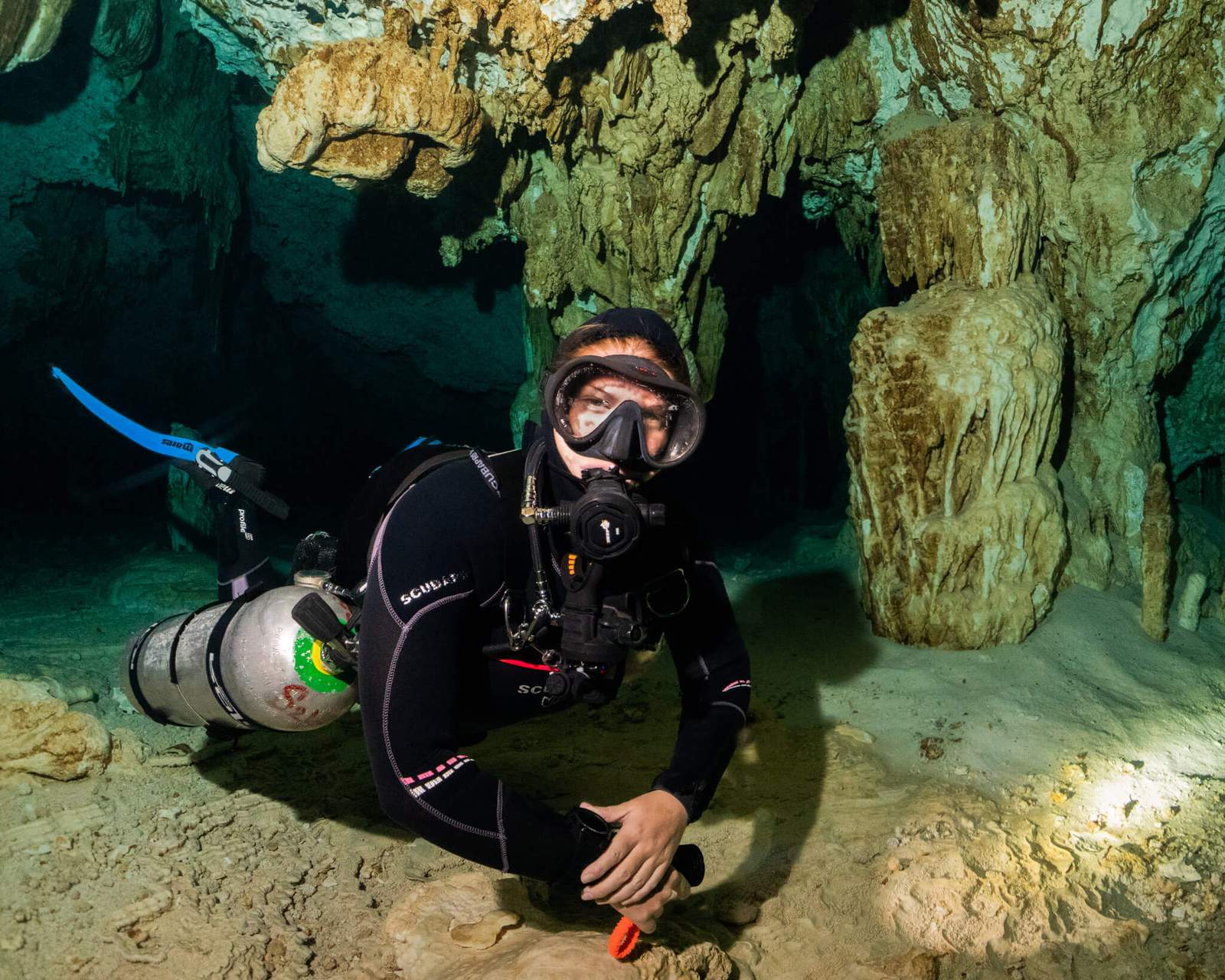
Other cenotes are shallow but advanced because they are fragile, darker, highly decorated, or psychologically more demanding. In those sites, the challenge is not depth. The challenge is precision. You need excellent trim, careful finning, calm breathing, and the ability to move through a delicate cavern environment without touching anything.
It is also important to distinguish cavern diving from cave diving. Recreational cenote dives take place in the cavern zone, while cave diving goes beyond that and requires specialized cave-diving training, equipment, and procedures. Cavern training focuses on the daylight zone, continuous guidelines, no decompression, no restrictions, and strict overhead-environment protocols.
With that foundation in mind, here are some of the best advanced cenote dives to consider.
1. The Pit
Best for: dramatic depth, light beams, haloclines, and big vertical scenery
Recommended for: Advanced Open Water divers with recent deep-diving experience
Main appeal: a spectacular sinkhole-style cenote with depth, light, and atmosphere
The Pit is one of the most famous advanced cenote dives near Tulum. It is not a tight cavern dive. It is a deep, vertical sinkhole with enormous scale, clear water, dramatic light, and a strong sense of descent.
For many divers, The Pit feels completely different from a shallow cavern route. You are not weaving through a decorated passage. You are descending into a large, deep space where sunlight can cut down from above and where the water layers create a very particular atmosphere.
Most recreational tours do not go anywhere near the true bottom. The dive is planned within recreational limits, commonly around 30 meters / 100 feet for guided advanced recreational dives, even though the cenote itself is much deeper. Blue Life notes that tours in The Pit are conducted to around 30 meters, while the maximum depth of the site is far beyond that.
This is not a dive for newly certified Open Water divers. It is a dive for people who are already comfortable with deep profiles, descent control, equalization, gas consumption at depth, and shorter no-decompression limits.
The Pit is especially good for divers who want a “wow” factor without a tight passage feeling. It is spacious, dramatic, and visually powerful. But because the depth comes quickly, divers need discipline. Descend slowly, stay with the guide, monitor your computer, and do not chase depth.
2. Angelita
Best for: the famous underwater “river” effect
Recommended for: Advanced Open Water divers with strong deep-diving comfort
Main appeal: hydrogen sulfide cloud, submerged trees, and a surreal sinkhole atmosphere
Angelita is one of the most surreal cenote dives in the Riviera Maya.
The main feature is the hydrogen sulfide cloud around 30 meters / 100 feet. From above, it can look like a misty river or a strange underwater forest floor, with branches and debris creating an atmosphere that feels almost unreal. Several local dive sources describe the main hydrogen sulfide feature at approximately 30 meters, which is why Angelita is generally treated as an advanced dive.
Angelita is not advanced because it is narrow or heavily decorated. It is advanced because of depth, atmosphere, and the psychological effect of the dive. You are descending into a deep sinkhole where the main attraction sits at the edge of standard Advanced Open Water limits. Your gas consumption is higher at that depth, your no-decompression time is shorter, and you need to remain calm and aware.
This is a dive where the briefing matters a lot. The guide should explain the descent, maximum depth, route, time at depth, ascent profile, and how the group will move around the cloud.
Angelita is a good choice for divers who want something completely different from reefs, caverns, and light-beam dives. It is quiet, strange, and unforgettable. But it should not be treated as a casual “second cenote ever” dive unless the diver is genuinely ready.
3. Zapote
Best for: unique formations and a deep sinkhole profile
Recommended for: Advanced Open Water divers with excellent buoyancy and comfort at 30 meters
Main appeal: the famous bell-shaped formations known as Hell’s Bells
Zapote is one of the most unusual cenote dives in the region. It is known for its large bell-shaped underwater formations, often called Hell’s Bells. These are not the typical stalactites and stalagmites divers see in other cenotes. They give the dive a strange, prehistoric feeling.
Zapote is also a deeper profile. Zapote has a maximum site depth of 63 meters / 208 feet, while recreational diving is conducted up to 30 meters / 100 feet.
That means the same rules apply: advanced certification, recent experience, good gas management, and stable buoyancy.
The formations are the highlight, but they should never be approached carelessly. Divers need to maintain position without drifting into the environment, kicking downward, or using the wall for support. This is not a site for a diver who still struggles to hover.
Zapote is a strong choice for experienced divers who want something rare. It is less about classic cavern beauty and more about geology, depth, and atmosphere. If you enjoy dives that feel different from everything else, Zapote deserves a place on your list.
4. Maravilla
Best for: photography, light beams, and hydrogen sulfide atmosphere
Recommended for: Advanced Open Water divers with good buoyancy and comfort in deeper cenotes
Main appeal: a huge light beam reaching toward the hydrogen sulfide layer
Maravilla is a spectacular cenote for divers who love light.
On the right day, a large beam of sunlight enters through the circular opening and drops dramatically through the water. Maravilla has a powerful light beam that can reach down to around 30 meters / 100 feet and illuminate the sulfur cloud.
This makes Maravilla especially attractive for underwater photographers and videographers. It has scale, contrast, and a clean visual composition: blue water, sunlight, depth, and cloud.
But Maravilla is still an advanced dive. Triton Diving describes it as requiring an advanced-level certification because of its hydrogen sulfide layer and overall dive profile.
The main mistake would be thinking of Maravilla as “easy” because it is visually open. Open space does not remove depth-related considerations. You still need to control descent, monitor gas, stay within the plan, and avoid letting photography distract you.
For photographers, this is especially important. A camera should never come before buoyancy, group position, or the guide’s instructions. If you are not stable without a camera, you are not ready to bring a large setup into a deeper cenote.
5. Dreamgate
Best for: advanced buoyancy, delicate formations, and intimate cavern scenery
Recommended for: experienced cenote divers with excellent trim and calm overhead comfort
Main appeal: shallow but highly decorated, fragile cavern routes
Dreamgate is a perfect example of why “advanced” does not always mean deep.
In terms of depth, Dreamgate is relatively shallow. With a maximum depth of around 7 meters / 23 feet.
Dreamgate is advanced because it is delicate, darker, highly decorated, and unforgiving of bad buoyancy. It is full of formations, and the environment requires very careful movement. Pluto Dive describes Dreamgate as recommended only for experienced divers with excellent buoyancy control and comfort in overhead environments because of its complexity and fragile nature.
This is a site for divers who already understand cenote behavior. You should know how to frog kick or use modified kicks, stay horizontal, avoid silting, control your light, and remain calm when the environment feels enclosed.
Dreamgate can be magical. It can also be stressful for the wrong diver. If someone is nervous in overhead environments, uses their hands to swim, or has poor fin awareness, this is not the right site.
For the right diver, however, Dreamgate is one of the most beautiful decorated cavern experiences in the area.
6. Taak Bi Ha and Taak Be Luum
Best for: experienced divers who love decorations, shallow profiles, and refined cavern control
Recommended for: divers with previous cenote experience and very good buoyancy
Main appeal: shallow, beautiful, decorated environments where precision matters more than depth
Taak Bi Ha and Taak Be Luum are not deep, but they are not casual beginner dives either.
These cenotes are about formations, shallow control, light, darkness, and delicate positioning. Taak Bi Ha and Taak Bi Lum are shallow dives around 7 meters / 23 feet, good buoyancy control is important because of the structure and environment. We emphasize that Taak Bi Ha requires excellent diving skills because of shallow water and fragile decorations, and may require previous cenote experience before diving there.
This kind of dive can actually be harder than some deeper sites for divers with weak buoyancy. In shallow water, small breathing changes can move you up or down more noticeably. When the environment is decorated and fragile, that lack of control becomes a problem.
These cenotes are best for divers who enjoy slow, precise diving. They are not about depth records or big vertical drama. They are about control, detail, and respect for a fragile place.
If you are the kind of diver who enjoys moving slowly, observing formations, and keeping perfect trim, these cenotes can be extremely rewarding.
How to Choose the Right Advanced Cenote
The best advanced cenote depends on what kind of diver you are.
If you want depth and dramatic scale, choose The Pit.
If you want the underwater river effect, choose Angelita.
If you want rare formations, choose Zapote.
If you want light beams and photography, choose Maravilla.
If you want delicate decorations and a buoyancy challenge, choose Dreamgate.
If you want shallow but refined cavern control, choose Taak Bi Ha or Taak Be Luum.
The wrong way to choose is by fame alone. A famous cenote is not automatically right for your level. The right cenote is the one that matches your certification, comfort, recent experience, buoyancy, and goals for the day.
What Skills Do Advanced Cenote Divers Need?
Advanced cenote diving rewards calm, controlled divers.
You should be able to hover without moving your hands. You should stay horizontal without dropping your fins. You should be able to descend slowly, stop at a planned depth, and control your breathing. You should monitor your gas without being reminded constantly. You should understand that a camera is secondary to safety and conservation.
For deeper cenotes, you also need awareness of no-decompression limits, narcosis, gas consumption, and ascent control. PADI notes that deeper dives require more attention to buoyancy, gas management, dive planning, no-stop limits, and narcosis risk.
For decorated cenotes, the key skill is environmental control. Do not touch. Do not kick. Do not silt. Do not use formations for balance. Do not swim above your ability just because the site is shallow.
An advanced diver is not someone who goes deeper.
An advanced diver is someone who makes good decisions.
When You Should Not Book an Advanced Cenote
Do not book an advanced cenote if you have not dived recently and have not done a refresher.
Do not book one if you are still struggling with buoyancy.
Do not book one if you are anxious in darker or enclosed environments.
Do not book one if your air consumption is very high and you have not worked on it.
Do not book one if you only want a photo and are not interested in the procedures.
Do not book one if you are trying to impress someone.
Advanced cenotes are best enjoyed when you are relaxed, prepared, and honest. There is no benefit in forcing the wrong dive. A well-chosen easier cenote will be more enjoyable than an advanced cenote done with stress.
Final Thoughts
The Riviera Maya has cenotes for every level of certified diver, but the advanced sites offer something especially powerful.
The Pit gives you scale and light. Angelita gives you a surreal hydrogen sulfide landscape. Zapote gives you formations unlike anything else. Maravilla gives you one of the most photogenic light-beam experiences in the region. Dreamgate gives you delicate, decorated cavern beauty. Taak Bi Ha and Taak Be Luum reward precise, careful divers.
None of these dives should be treated casually.
Advanced cenote diving is not about collecting names. It is about matching the dive to the diver. The right guide, the right group size, the right certification, and the right mindset matter more than the logo on your certification card.
If you are ready, these cenotes can be unforgettable.
If you are not ready yet, build up gradually. Do easier cenotes first. Improve your buoyancy. Get comfortable with freshwater, guidelines, lights, and cavern briefings. Then move toward the more demanding sites.
The cenotes are not going anywhere.
Dive them when you are ready to do them well.
Frequently asked questions
What are the best cenotes for advanced divers near Playa del Carmen and Tulum?+
Do I need Advanced Open Water for advanced cenotes?+
Is The Pit suitable for Open Water divers?+
Why is Angelita considered an advanced cenote?+
Is Dreamgate deep?+
What is the most photogenic advanced cenote?+
What is special about Zapote?+
Are advanced cenotes the same as cave dives?+
What skills should I have before booking an advanced cenote?+
Can I bring a camera on an advanced cenote dive?+
Which advanced cenote should I do first?+
Are advanced cenotes safe?+
Related articles
The Best Cenote Diving Routes for First-Time Cavern Divers
For many certified divers visiting the Riviera Maya, cenote diving is the experience they are most curious about — and sometimes the one they feel most unsure about. That makes sense. Cenotes are not ocean dives. They are…
What to Expect on a Full Day Cenote Diving Trip from Playa del Carmen
A full day of cenote diving from Playa del Carmen is one of the easiest ways to experience the underground world of the Riviera Maya without needing to be a cave diver. You leave the town, drive into the jungle, gear up beside a…
Cavern Diving vs. Cave Diving: What Recreational Divers Need to Know Before Diving Cenotes
Cenote diving is one of the main reasons certified divers travel to Playa del Carmen, Tulum, and the Riviera Maya. The water is clear, the limestone formations are beautiful, and the atmosphere is completely different from ocean…