
Haloclines, Light Beams and Hydrogen Sulfide: The Science Behind Cenote Diving
Cenote diving can feel almost unreal the first time you experience it. You descend into clear freshwater, sunlight cuts through openings in the jungle, limestone walls appear around you, and suddenly the underwater world feels…
Cenote diving can feel almost unreal the first time you experience it.
You descend into clear freshwater, sunlight cuts through openings in the jungle, limestone walls appear around you, and suddenly the underwater world feels less like the ocean and more like entering a hidden cathedral. Then, in certain cenotes, the water itself begins to shimmer. Your vision becomes blurry for a moment. A diver in front of you looks distorted, as if you are seeing them through heat waves. In other places, a strange cloud may appear below you, creating the illusion of an underwater river or a mysterious layer between two worlds.
These effects are not magic, even if they feel that way.
They are the result of geology, light, chemistry, freshwater, saltwater, and the unique structure of the Yucatán Peninsula. Understanding them does not make cenote diving less special. In fact, it often makes the experience even more impressive.
This article explains three of the most fascinating natural phenomena in cenote diving: haloclines, light beams, and hydrogen sulfide clouds.
Not every cenote has all three. Some cenotes are famous for light. Some are known for haloclines. Others have hydrogen sulfide layers. Some have none of these in a dramatic way but are still beautiful for other reasons. The important thing is to understand what you are seeing, where it comes from, and why these environments need to be treated with care.
First, Why Do Cenotes Exist?
To understand the science behind cenote diving, you need to start with the land itself.
The Yucatán Peninsula is largely made of limestone. Limestone is a soluble rock, which means it can be slowly dissolved by slightly acidic water. Rainwater absorbs carbon dioxide from the air and soil, forming weak carbonic acid. Over long periods of time, that water seeps into the ground and dissolves the limestone, creating cavities, tunnels, caves, and underground rivers.
When the roof of one of these cavities collapses or opens to the surface, a cenote is formed. NASA describes cenotes as sinkholes associated with karst terrain, formed where groundwater dissolves calcium carbonate rocks such as limestone.
This is why cenotes are so closely connected to cave systems. Many of them are not isolated pools. They are windows into a much larger underground aquifer.
For divers, that means cenotes are not just “freshwater holes.” They are entrances into a geological system shaped by water, rock, time, and sea-level change.
What Is a Halocline?
A halocline is a boundary between water layers with different salinity.
In the Riviera Maya, cenotes often contain freshwater near the top. In some systems, deeper layers may contain saltwater or brackish water, especially where the underground aquifer connects toward the coast. Freshwater is less dense than saltwater, so the fresher water tends to sit above the saltier water.
Where those two layers meet, you get a halocline.
To a diver, a halocline looks like a shimmering, blurry, wavy layer in the water. It can feel as if your mask is fogging up, but it is not your mask. It is the water itself bending light differently because the freshwater and saltwater have different densities and refractive properties.
When you pass through a halocline, visibility can become temporarily distorted. A diver’s fins may look stretched or wavy. The guideline may seem to ripple. Your own hand can look strange in front of your face.
This is one of the most memorable visual effects in cenote diving.
Why Does a Halocline Look Blurry?
The blurry effect happens because light changes direction when it passes through water layers of different densities. This is called refraction.
Think of how a straw looks bent when placed in a glass of water. The straw is not actually bent; light is changing direction as it moves between air and water. In a halocline, something similar happens underwater, but instead of air and water, the contrast is between fresher water and saltier water.
If the layers are relatively undisturbed, the halocline can appear as a defined shimmering boundary. If divers swim through it, the layers mix temporarily and the blurry effect increases.
This is why good finning matters. Strong kicks, vertical body position, or unnecessary movement can disturb the halocline and reduce visibility for the group behind you.
Haloclines are not unique to cenotes, but cenotes make them especially visible because the water can be exceptionally clear and calm.
Do All Cenotes Have Haloclines?
No. This is important.
Not all cenotes have a visible halocline at recreational diving depths. Some cenotes are mostly freshwater within the areas divers visit. Others may have a halocline deeper down. Some coastal systems show stronger interaction between freshwater and saltwater, while inland cenotes may have different conditions.
The depth and visibility of a halocline depend on factors such as distance from the coast, aquifer flow, rainfall, recharge, cave-system connectivity, and the local structure of the underground system. Scientific descriptions of Yucatán cenotes explain that fresh groundwater and saline water can form density layers, with the position of the interface varying across the peninsula.
For divers, the simple version is this: if your guide says a cenote has a halocline, expect a visual distortion layer. If they do not mention one, do not assume you will see it.
What Are Light Beams in Cenotes?
Light beams are one of the most iconic parts of cenote diving.
They happen when sunlight enters the water through openings in the cenote roof, jungle canopy, or cavern entrance. Because many cenotes have clear water and darker surrounding rock, the sunlight can appear as visible shafts cutting through the water.
In the ocean, light often spreads broadly through the water column. In cenotes, light is more directional. It may enter through a small opening, hit the water at a specific angle, and create a dramatic column or curtain of light.
This is why some cenote dives feel almost theatrical. You are not just seeing sunlight. You are seeing sunlight shaped by rock, water, angle, depth, and darkness.
Why Are Some Cenotes Better for Light Beams Than Others?
Light beams depend on several factors:
- the shape of the cenote opening
- the angle of the sun
- the time of day
- the season
- cloud cover
- water clarity
- the amount of open space inside the cenote
- how dark the surrounding cavern is
A cenote with a wide open entrance may be bright and beautiful, but not always dramatic. A cenote with a smaller opening and darker cavern chamber may create stronger beams because the contrast is higher.
This is also why timing matters. A cenote that looks spectacular at one time of day may look very different a few hours later. On a sunny day, the light can be sharp and defined. On a cloudy day, the same site may feel softer, moodier, and less dramatic.
Neither version is wrong. They are just different experiences.
Why Cenote Light Feels Different from Ocean Light
Ocean light is usually open and expansive. It lights reefs, sand, fish, and blue water from above.
Cenote light is more architectural.
It enters through openings, reflects from limestone, disappears into darker rooms, and creates strong contrasts. You may be swimming in shadow while a column of sunlight glows a few meters away. You may look back toward the entrance and see divers silhouetted against bright blue water. You may pass from a sunlit area into a darker cavern zone where your dive light becomes more important.
That contrast is one of the reasons cenote diving is so memorable. It changes the emotional tone of the dive. The ocean often feels alive and moving. A cenote often feels still, quiet, and ancient.
What Is a Hydrogen Sulfide Cloud?
A hydrogen sulfide cloud is a layer that can form in some cenotes under specific conditions, usually where decomposing organic matter and low-oxygen conditions contribute to the production or accumulation of hydrogen sulfide.
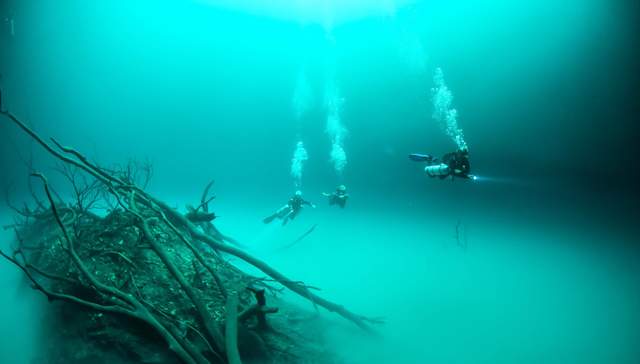
To divers, it may look like a white, grey, or misty cloud suspended underwater. In famous cenotes such as Angelita, this effect can create the illusion of an underwater river, with tree branches or debris appearing to rest at the boundary. It is one of the most surreal sights in cenote diving.
But hydrogen sulfide clouds are not present in every cenote. They are site-specific phenomena. You should not describe cenote diving in general as if every cenote has one.
They are also not something divers should treat casually. The guide’s briefing matters. Divers should follow the planned route, avoid unnecessary disturbance, and respect depth and training limits.
Is Hydrogen Sulfide Dangerous for Divers?
In the context of recreational cenote diving, divers encounter hydrogen sulfide clouds only in specific sites and under guided conditions. The main practical issue for most divers is not “touching” the cloud with their hands, but diving beyond their training, exceeding safe depth limits, getting disoriented, or treating the site like a normal open-water dive.
Hydrogen sulfide itself is a toxic gas in air at sufficient concentrations, but underwater cenote diving involves very specific environmental conditions and procedures. Divers should not generalize or panic, but they should take the briefing seriously and avoid unsupported assumptions.
The safest way to think about it is simple: if a cenote has a hydrogen sulfide layer, your guide will explain how the dive is conducted, what depth range is involved, what you will see, and what rules apply.
Do not descend into deeper layers just because they look interesting. Do not leave the guide. Do not treat visual curiosity as a reason to break the plan.
Why Do Hydrogen Sulfide Clouds Look Like Underwater Rivers?
The underwater river effect happens because the cloud forms a visible layer. It separates visually from the clearer water above it, and objects such as branches, leaves, or debris can create the impression of a riverbank or forest floor.
In Angelita, this effect is especially famous because the hydrogen sulfide layer can look like a river flowing through the cenote. It is not actually a river in the normal sense. It is a chemical and visual boundary that creates a river-like illusion.
This is a good example of why cenote diving feels so dreamlike. Your eyes are seeing something real, but your brain interprets it using familiar surface-world references: clouds, fog, rivers, forests, sunlight, shadows.
Underwater, those references become strange.
How These Phenomena Affect the Diving Experience
Haloclines, light beams, and hydrogen sulfide clouds are not just visual extras. They change how the dive feels.
A halocline can make the water seem alive, as if the environment is shifting around you. Light beams create a sense of scale and drama. Hydrogen sulfide clouds can make a cenote feel otherworldly and mysterious.
But they also reinforce the need for control.
In a cenote, the best divers are not the fastest or the most adventurous. They are the calmest. They maintain buoyancy, stay in trim, move slowly, and avoid disturbing the water, the bottom, or the formations.
Poor technique can ruin visibility, damage fragile features, or make the dive less enjoyable for everyone behind you.
Good technique allows the environment to reveal itself.
The Role of Limestone Formations
The science of cenote diving is not only about water layers and light. The rock itself is part of the experience.
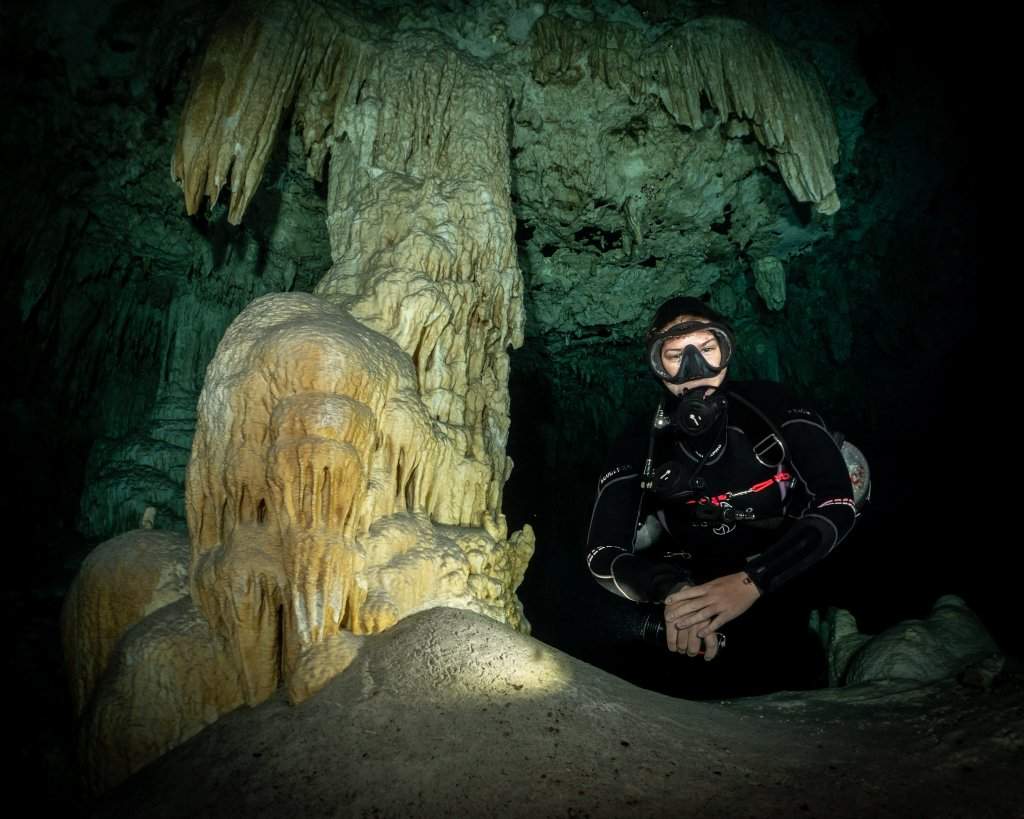
Many cenotes contain stalactites, stalagmites, columns, and other limestone formations. These features formed over long periods when cave passages were dry or partially dry. Mineral-rich water dripped from ceilings, deposited calcium carbonate, and slowly built formations drop by drop.
When sea levels changed and cave systems flooded, some of those formations became part of the underwater landscape.
This is one reason cenote formations are so fragile. They were not created quickly, and they cannot be replaced on a human timescale. A single careless fin kick or hand contact can damage something that took thousands of years to form.
That is why “do not touch” is not just a polite rule. It is a conservation requirement.
Why Cenote Water Is So Clear
Cenote water can be extremely clear because it is filtered through limestone and because many cenotes are protected from waves and surf. There is no ocean swell stirring up sand in the same way you might experience near a beach. In many sites, the water is calm, and particles settle unless disturbed.
But this clarity can be fragile. Fine sediment may sit on the bottom or on rock surfaces. If divers kick it up, visibility can drop. In overhead environments, reduced visibility becomes a serious safety concern.
So the same condition that makes cenotes visually stunning also demands better technique. Clear water is not an excuse to be careless. It is a reason to be even more precise.
Why Understanding the Science Makes You a Better Cenote Diver
You do not need to be a geologist or chemist to enjoy cenote diving. But understanding the basic science helps you dive with more awareness.
When you know what a halocline is, you do not panic when visibility becomes blurry for a few seconds. When you understand how light beams depend on sun angle, you appreciate why the same cenote can look different from one day to another. When you know hydrogen sulfide clouds are site-specific and depth-related, you avoid making inaccurate assumptions about every cenote.
Most importantly, understanding the science helps you respect the environment.
Cenotes are not theme parks. They are natural freshwater systems, cultural sites, geological archives, and fragile ecosystems. AP has reported on Indigenous Maya communities seeking stronger protection for cenotes because of their cultural significance and vulnerability as freshwater sources.
As divers, we are visitors inside that environment.
Final Thoughts
The science behind cenote diving is part of what makes it unforgettable.
Haloclines show you where freshwater and saltwater meet. Light beams reveal the architecture of the cenote. Hydrogen sulfide clouds, in specific sites, create one of the strangest visual effects in recreational diving. Limestone formations tell the story of caves that existed long before they were flooded.
Together, these elements create an underwater experience that is completely different from reef diving.
The best way to enjoy them is not to rush. Move slowly. Stay close to your guide. Control your buoyancy. Keep your fins away from the bottom. Listen carefully during the briefing. And remember that not every cenote offers the same phenomena.
Some cenotes are about light. Some are about formations. Some are about depth and atmosphere. Some are about calm, open water. Each one has its own personality.
That is what makes cenote diving so special.
You are not just diving through water. You are diving through geology, chemistry, light, and time.
Frequently asked questions
What is a halocline in cenote diving?+
Do all cenotes have haloclines?+
Why does the water look blurry in some cenotes?+
What creates light beams in cenotes?+
When is the best time to see light beams in cenotes?+
What is a hydrogen sulfide cloud in a cenote?+
Which cenotes are known for hydrogen sulfide clouds?+
Is the hydrogen sulfide cloud an actual underwater river?+
Are cenote formations fragile?+
Why is buoyancy control so important in cenote diving?+
Related articles
A Diver’s Guide to Cenote Formations: Stalactites, Stalagmites and Ancient Caves
One of the most unforgettable parts of cenote diving is realizing that you are not just diving through water. You are diving through an ancient cave system. Unlike reef diving, where the main scenery is coral, sponges, fish, and…
The Best Cenote Diving Routes for First-Time Cavern Divers
For many certified divers visiting the Riviera Maya, cenote diving is the experience they are most curious about — and sometimes the one they feel most unsure about. That makes sense. Cenotes are not ocean dives. They are…
Cenote Diving Season Guide: When Is the Best Time to Dive Cenotes in Mexico?
One of the best things about cenote diving in Mexico is that there is no single “bad” season to do it. Unlike ocean diving, where wind, waves, current, plankton blooms, visibility, and marine life seasons can dramatically change…