
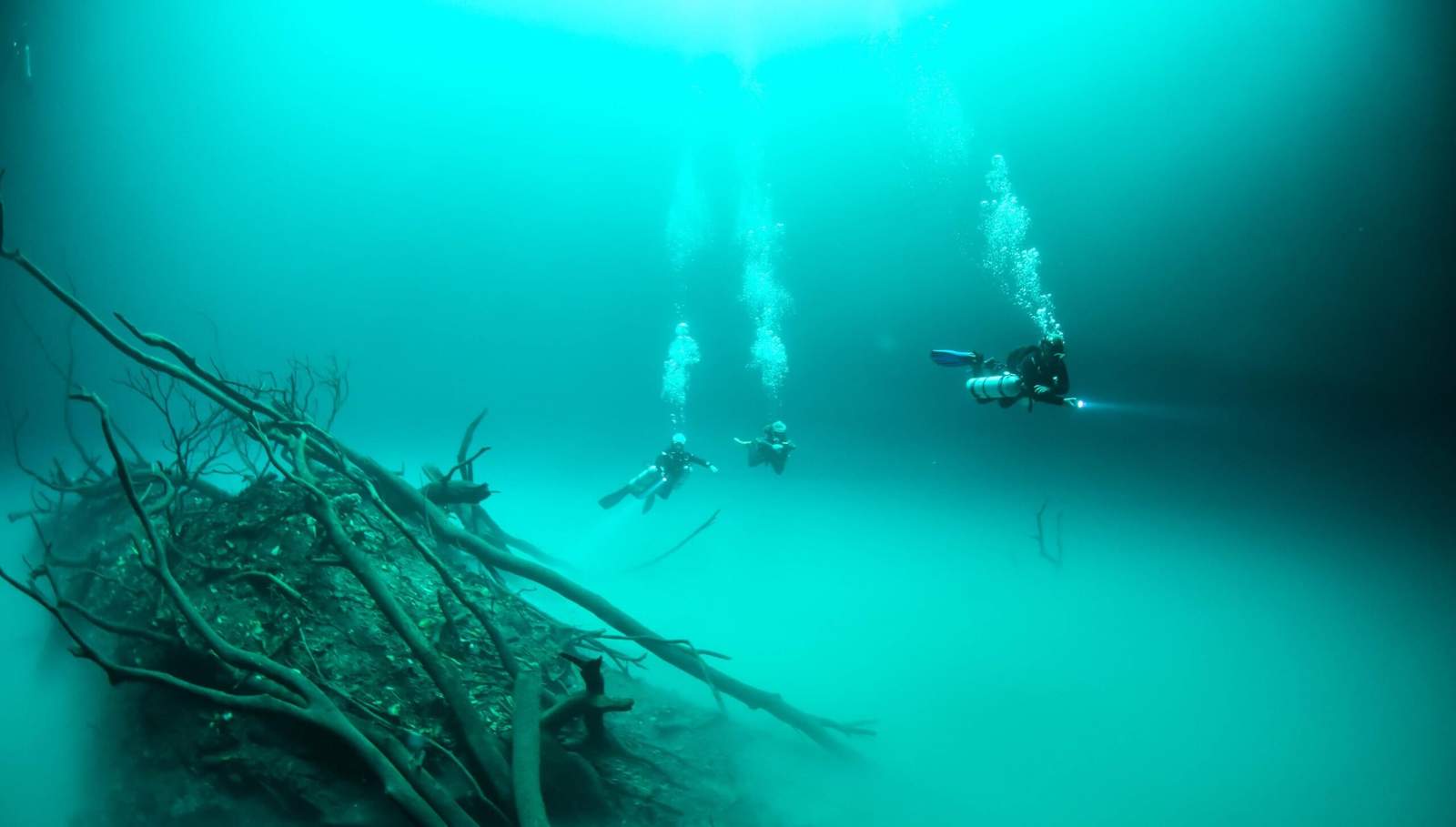
A Diver’s Guide to Cenote Formations: Stalactites, Stalagmites and Ancient Caves
One of the most unforgettable parts of cenote diving is realizing that you are not just diving through water. You are diving through an ancient cave system. Unlike reef diving, where the main scenery is coral, sponges, fish, and…
One of the most unforgettable parts of cenote diving is realizing that you are not just diving through water.
You are diving through an ancient cave system.
Unlike reef diving, where the main scenery is coral, sponges, fish, and open blue water, cenote diving is built around rock, light, silence, and time. The shapes around you were not placed there for divers. They were formed slowly by water, minerals, gravity, collapse, and changing sea levels.
You may swim below stalactites hanging from the ceiling. You may pass beside stalagmites rising from the floor. You may see columns where the two have met. In some cenotes, the formations look like curtains, frozen waterfalls, towers, teeth, blades, or cathedral architecture.
For many divers, that is the moment cenotes become truly special.
This guide explains what those formations are, how they were created, why many of them are now underwater, and why divers must treat them with extreme care.
First, What Exactly Are Cenote Formations?
The formations divers see in cenotes are usually called speleothems.
A speleothem is a mineral deposit that forms inside a cave. The most famous examples are stalactites and stalagmites, but there are many other types: columns, flowstone, draperies, soda straws, rimstone, and other calcite formations.
In simple terms, many speleothems form when water moves through limestone, dissolves minerals, enters an air-filled cave, and then redeposits calcium carbonate over time. The U.S. National Park Service explains that stalactites and stalagmites form when water dissolves limestone and redeposits calcium carbonate on cave ceilings or floors.
That process is slow. Very slow.
This is why cenote formations should never be touched, kicked, grabbed, or used for balance. They are not decorations in a swimming pool. They are geological records.
Stalactites: The Formations Hanging from the Ceiling
Stalactites are the formations that hang downward from the ceiling.
A useful way to remember the word is: stalactites hold tight to the ceiling.
They often begin when mineral-rich water drips from the cave roof. As the water loses carbon dioxide and deposits calcium carbonate, a tiny ring or tube can begin to form. Over long periods, that deposit grows downward.
Some stalactites are thick and heavy-looking. Others are thin, hollow, and delicate. These very thin tube-like formations are often called soda straws. They can be beautiful, but they are extremely fragile.
When you are diving below stalactites, your buoyancy matters. Your tank, fins, bubbles, camera, or careless hand movement can damage formations that took far longer to grow than any human lifetime.
A good cenote diver never assumes there is “plenty of space.” They stay aware of the ceiling, their tank valve, their fins, their light, and their position in the group.
Stalagmites: The Formations Rising from the Floor
Stalagmites grow upward from the cave floor.
They often form where water dripping from a stalactite hits the ground and leaves behind mineral deposits. Drop by drop, layer by layer, the mound grows.
A simple memory trick is: stalagmites might reach the ceiling one day.
Stalagmites can look like cones, towers, piles, rounded mounds, or thick stone candles. In cenotes, they are often partly buried, submerged, or surrounded by collapsed rock and sediment.
For divers, stalagmites create a different problem from stalactites. Instead of watching the ceiling, you must watch your fins and knees. A diver in poor trim can easily drop toward the floor, kick a formation, or stir sediment around it.
This is one reason why horizontal trim is so important in cenote diving. It protects the formations and preserves visibility for the divers behind you.
Columns: When Stalactites and Stalagmites Meet
Sometimes, a stalactite growing down from the ceiling and a stalagmite growing up from the floor eventually meet. When they connect, they form a column.
Columns can look like natural pillars, and in some cenotes they create the feeling of swimming through an underwater temple. The National Park Service describes columns as formations created when stalactites and stalagmites continue forming until they meet, creating a post from floor to ceiling.
For divers, columns are visually powerful because they give the cave a sense of architecture. But they are not architecture in the human sense. Nobody designed them. Nobody built them. They are the result of water and mineral deposition over long periods of time.
That is part of what makes them so impressive.
Flowstone, Draperies and “Frozen Waterfalls”
Not all cenote formations grow as pointed spikes.
Some form in sheets. These are often called flowstone.
Flowstone develops where mineral-rich water flows along cave walls or floors and leaves behind layers of calcium carbonate. Over time, it can create smooth sheets, rippled surfaces, or formations that look like frozen waterfalls.
In some caves, flowstone can also form curtain-like shapes known as draperies. These can look like folded fabric made of stone. The National Park Service describes flowstone as calcium carbonate sheets that form along cave walls and may create curtain-like draperies.
In cenote diving, these formations can be stunning under a dive light. The texture becomes visible from the side: folds, ridges, layers, and mineral patterns.
But the rule remains the same: look, do not touch.
Why Are These Formations Underwater?
This is one of the most interesting questions in cenote diving.
Many classic stalactites and stalagmites form in air-filled cave passages, not fully flooded ones. So if you are seeing them underwater today, that usually means the cave was once dry or partly dry when those formations developed. Later, the cave flooded.
How did that happen?
The Yucatán Peninsula has been shaped by limestone, groundwater, and major sea-level changes. During lower sea-level periods, some cave passages were air-filled. As sea levels rose after glacial periods, many passages flooded again. A Northwestern University karst geology overview explains that when sea level dropped, some submerged caves became air-filled, and when sea level rose later, many passages and caves were flooded again.
That means the formations you see underwater are evidence of a different chapter in the cave’s history.
You are not just looking at rock. You are looking at a former dry cave that became part of a flooded aquifer system.
That is one of the reasons cenote diving feels so different from ocean diving. The environment is not only underwater scenery. It is geological memory.
How Cenotes and Caves Formed in the First Place
The Yucatán Peninsula is famous for cenotes because of its limestone geology.
Limestone dissolves slowly when slightly acidic water moves through it. Rainwater absorbs carbon dioxide from the air and soil, becomes weakly acidic, and enters cracks and pores in the rock. Over very long periods, that water enlarges pathways, creates cavities, and forms underground drainage systems.
Eventually, some cave roofs collapse or open to the surface, creating cenotes. In the Riviera Maya, many cenotes are windows into a much larger network of flooded caves and underground rivers.
Associated Press, reporting on the region’s cave systems, described the Yucatán underground environment as a fragile network of subterranean caverns, rivers, lakes, and freshwater sinkholes, formed as water sculpted porous limestone over millions of years.
For divers, this explains why cenotes are so varied. Some are open and bright. Others are cavern-like. Some are deep shafts. Some connect to huge cave systems. Some have delicate formations. Some are mostly about light and water clarity.
They all belong to the same broad geological story, but each cenote expresses it differently.
Why Some Cenotes Have More Formations Than Others
Not every cenote is full of stalactites and stalagmites.
Some cenotes are famous for formations. Others are known for light beams, haloclines, depth, hydrogen sulfide clouds, open water, or jungle scenery.
There are several reasons for this:
The cave’s history
A passage that spent long periods as an air-filled cave had more opportunity to develop dripstone formations.
Water movement
Different water flow patterns create different shapes. Dripping water may form stalactites and stalagmites. Flowing water may create flowstone or smoother surfaces.
Collapse history
Some cenotes contain large areas of breakdown, where sections of ceiling or wall have collapsed. These areas may look more rugged and less decorated.
Sediment and flooding
Some formations may be partially buried, hidden, eroded, or less visible depending on sediment and water conditions.
Human impact
Unfortunately, fragile cave environments can be damaged by careless tourism, construction, pollution, or divers who do not control their buoyancy.
So, if one cenote has dramatic decorations and another does not, it does not mean one is “better.” It means they tell different parts of the story.
Why Formations Are So Fragile
Cenote formations may look solid, but they are often fragile.
A small soda straw can break with a light touch. A thin curtain can chip. A stalactite can be damaged by a tank valve or camera. Even touching a formation with your hand can leave oils that affect mineral surfaces. The National Park Service warns that many cave formations took thousands of years to form and can be permanently damaged by something as simple as hand contact.
Underwater, the risk increases because divers are moving in three dimensions. You may think you are far enough away, but your fins, tank, pressure gauge, light cord, or camera arm may be closer than you realize.
This is why guides insist on good buoyancy and proper positioning.
In a cenote, “do not touch” is not a casual suggestion. It is a serious conservation rule.
Buoyancy: The Skill That Protects the Cave
The best way to respect cenote formations is to dive with excellent buoyancy.
That does not mean being “good enough” to stay off the bottom most of the time. It means being in control at all times.
A good cenote diver should be able to:
- hover calmly without using hands
- stay horizontal
- keep fins away from the floor
- avoid rising into the ceiling
- move slowly
- stop without crashing into anything
- adjust depth with breathing and small buoyancy changes
- stay close to the guide without crowding other divers
This is especially important in decorated cenotes. Some routes have formations above, below, and beside you. You are not just avoiding the bottom. You are protecting the whole space around your body.
If your buoyancy is not ready, choose an easier cenote first. There is no shame in that. It is better to build skill gradually than to damage a fragile site.
Finning Technique Around Formations
Bad finning is one of the fastest ways to damage a cenote environment.
Large flutter kicks can push water downward, stir sediment, and bring your fins dangerously close to formations. Bicycle kicking often drops the knees and fins. Fast swimming reduces awareness and makes it harder to stop gently.
In many cenote routes, a controlled frog kick or modified frog kick is more appropriate because it directs water backward instead of downward. But technique should always match the space and your training.
The main principle is simple: move less water.
Slow down. Use smaller kicks. Keep your fins up. Glide when possible. Avoid sudden turns. Do not kick while looking backward unless you know exactly where your fins are.
A careful diver sees more because they disturb less.
Why Divers Should Not Take Souvenirs
Nothing should be removed from a cenote.
Not a rock. Not a fossil. Not a broken formation. Not a shell. Not a bone. Not a pottery fragment. Not anything that “looks abandoned.”
Cenotes can contain geological, ecological, paleontological, or archaeological material. Even when something looks insignificant, it belongs to the site.
Removing objects damages the integrity of the environment. It also encourages a mindset that cenotes are there to be consumed rather than respected.
A responsible diver takes photos and memories, not pieces of the cave.
The Feeling of Diving Through Ancient Caves
What makes cenote formations so powerful is not only how they look.
It is how they change the feeling of the dive.
On a reef, your eyes are often searching for movement: fish, turtles, rays, moray eels, coral heads, cleaning stations. In a cenote, the beauty is more still. The formations do not perform for you. They simply exist.
A stalactite hanging in clear water.
A column disappearing into shadow.
A curtain of limestone lit by your torch.
A collapsed chamber with sunlight behind it.
A line of formations that once grew in dry air and now sits underwater.
The experience feels quiet because the scale of time is different.
You are swimming through something older than the dive industry, older than modern tourism, older than the towns around it. That perspective usually makes divers more careful.
And that is exactly how cenotes should make us feel.
Best Cenote Types for Seeing Formations
If your main interest is cave formations, you should tell your dive center before booking. Not every beginner-friendly cenote is formation-heavy, and not every decorated cenote is suitable for every diver.
Some cenotes are better for first-time divers who want open space and light. Others are better for experienced divers with excellent buoyancy who want delicate decorations and a stronger cavern atmosphere.
In general:
First-time cenote divers should choose easier routes where formations can be enjoyed without psychological stress.
Confident divers with good buoyancy may be ready for more decorated cavern routes.
Advanced or very experienced divers may be able to visit deeper or more atmospheric cenotes, depending on certification and conditions.
The right choice depends on your level. A formation-rich cenote is not worth it if you spend the whole dive stressed, overweighted, or worried about hitting something.
Final Thoughts
Cenote formations are one of the great highlights of diving in the Riviera Maya.
Stalactites, stalagmites, columns, flowstone, draperies, and collapsed chambers tell the story of caves that changed over time. Some formations grew when passages were dry. Later, rising water levels flooded those spaces, creating the underwater landscapes divers visit today.
That is why cenote diving feels so unique. You are not only seeing a beautiful dive site. You are seeing geology in slow motion — limestone dissolved, caves opened, minerals deposited, ceilings collapsed, sea levels changed, and water returned.
But beauty comes with responsibility.
Do not touch. Do not kick. Do not take. Do not rush. Do not treat formations as props for photos. Control your buoyancy. Respect the guide. Stay on the route. Leave the cenote exactly as you found it.
The formations were there long before you arrived.
The goal is to make sure they remain there long after you leave.
Frequently asked questions
What are the formations inside cenotes called?+
What is the difference between stalactites and stalagmites?+
How do columns form in cenotes?+
Did cenote formations form underwater?+
Are cenote formations still growing?+
Why are cenote formations so fragile?+
Can divers touch stalactites or stalagmites?+
Why is buoyancy important around cenote formations?+
Which cenotes are best for seeing formations?+
Can I take a broken piece of formation from a cenote?+
Related articles
Haloclines, Light Beams and Hydrogen Sulfide: The Science Behind Cenote Diving
Cenote diving can feel almost unreal the first time you experience it. You descend into clear freshwater, sunlight cuts through openings in the jungle, limestone walls appear around you, and suddenly the underwater world feels…
Cenote Diving Season Guide: When Is the Best Time to Dive Cenotes in Mexico?
One of the best things about cenote diving in Mexico is that there is no single “bad” season to do it. Unlike ocean diving, where wind, waves, current, plankton blooms, visibility, and marine life seasons can dramatically change…
Cavern Diving vs. Cave Diving: What Recreational Divers Need to Know Before Diving Cenotes
Cenote diving is one of the main reasons certified divers travel to Playa del Carmen, Tulum, and the Riviera Maya. The water is clear, the limestone formations are beautiful, and the atmosphere is completely different from ocean…