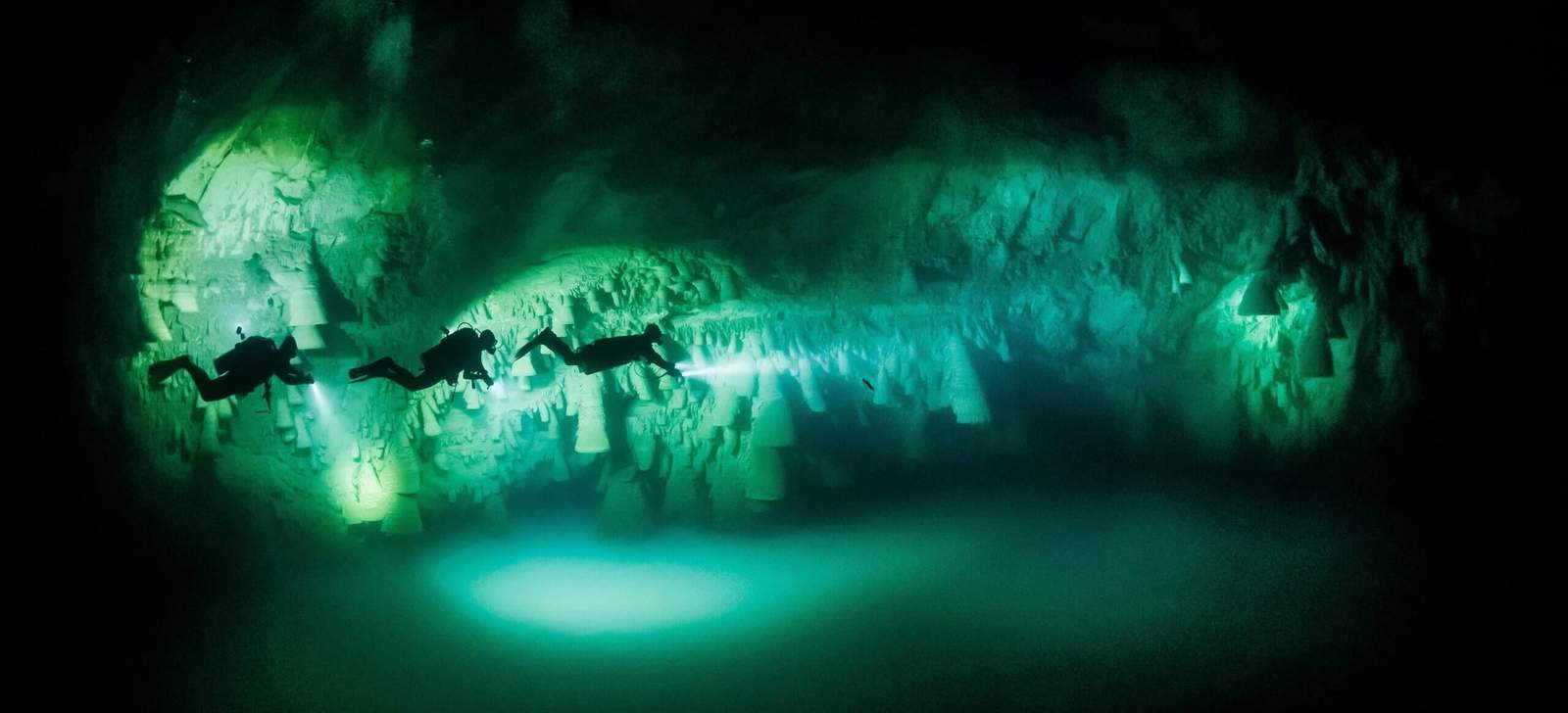
Home to the world famous Hells Bells
A mystical place full of a thick sulfur cloud and the bizarre Hells Bells. A truly unique dive that had scientists puzzled for over a decade over these newly reported formations.
| Zapote — Scuba Tour Info | |
|---|---|
| All Inclusive Price | $219 USDcombined with one dive in Maravilla *minimum two divers$199 USDPrice with your own equipment |
All Inclusive Price:
| |
*This cenote charges a fee for the use of an underwater camera. The fee depends on the size and type of camera
Small groups, private guides and premium gear included. Send us a message and we will confirm availability.
Cenote Zapote is a truly unique dive with its famous Hell’s Bells! Massive formations shaped like bells reaching up to 4m/13ft in diameter. It took scientists a decade of study to discover exactly how they grow. Finally realizing they were built while submerged in the water by living organisms.
Called biothems these natural sculptures are formed by bacteria breathing and solidifying calcium and are still growing! Only reported in about 30 caves worldwide, they are very rare as they need special conditions in which to grow (scroll down for more) and Zapote has the most extensive display of such bells researchers have ever found.
Descend into the hourglass shaped cenote and as you pass through the neck the first thing you will see is a massive 4500 year old tree protruding from a thick sulfide cloud. Enter further into the lower chamber and will start to see the hundreds of incredible formations.
Zapote is named after the Sapote trees growing nearby, an evergreen tree native to southern Mexico cultivated for its soft edible fruits, medicinal oil of the seeds and wood.
We fit your gear, run through the plan for the day and load the truck.
We stop on the way to pick up lunch and tanks.
Being the first ones in the water makes the whole experience far more magical — empty caverns, untouched sulfur cloud.
Full dive briefing, then we kit up together.
Time to warm up, eat and share the first impressions.
Drive home, reliving all the amazing moments of the day.
This cenote is a one tank dive and is best combined with a dive in Cenote Maravilla. It is an advanced dive and requires that we have seen your ability over a few cenote dives before we will consider taking you here.
We suggest you bring a towel and a dry set of clothes. Keep in mind as in all cenotes sunscreen, cosmetics and insect repellent are banned due to the conservation of the site.
Cenote Zapote was discovered in the late 20th century, but it only gained significant attention in the 2010s due to its unique features.
These calcareous structures were yet unreported in scientific literature and were clearly not regular stalactites. Dating confirmed that the bells are young (< 4500 years) and were formed in a subaquatic environment. They need very specific conditions in which to grow, meaning they are only found in a few places worldwide.
They require lightless conditions in a stratified body of water which is characterized by the freshwater overlying the saltwater, with a stagnant transition zone (halocline) of several meters. This combined with the large amount of organic material that is washed into the cenote by rain creating the hydrogen sulfide layer, provides a unique environment for the tiny creatures called extremophiles.
In this extreme noxious environment they thrive on the hydrogen sulfide for energy. In this process they change the chemical composition of the water just above the halocline, raising the PH level and creating the very specific conditions in which the bells can form.
In fact the outer surface of the bells is alive, sulfur-powered organisms similar to those in the halocline cover the outside of all the bells, continually contributing to the calcium buildup. As these creatures need these harsh conditions to thrive, the growth of Hells Bells is strictly dependent on the elevation of the halocline. The bells in Zapote are found in a roughly 8m/25ft range, from around 27m/90ft to 35m/115ft deep, indicating the halocline level was once higher.
Zapotes bell biothems are unique in shape and found almost nowhere else on Earth. This is likely due to the cenote’s hourglass shape researchers theorized. The bells may have been shaped around rising carbon dioxide bubbles trapped against the almost horizontal ceiling and once the formations develop a in circular shape, they continue to grow that way.
Vincente Fito who first discovered the bells in 2011 also discovered a giant sloth skeleton (Xibalbaonyx oviceps) deeper in the cenote. They called the sloth Pote and he lived between 10647 and 10305 BC when the caverns were dry or with little water.
Send us your dates and we will build your perfect dive day.